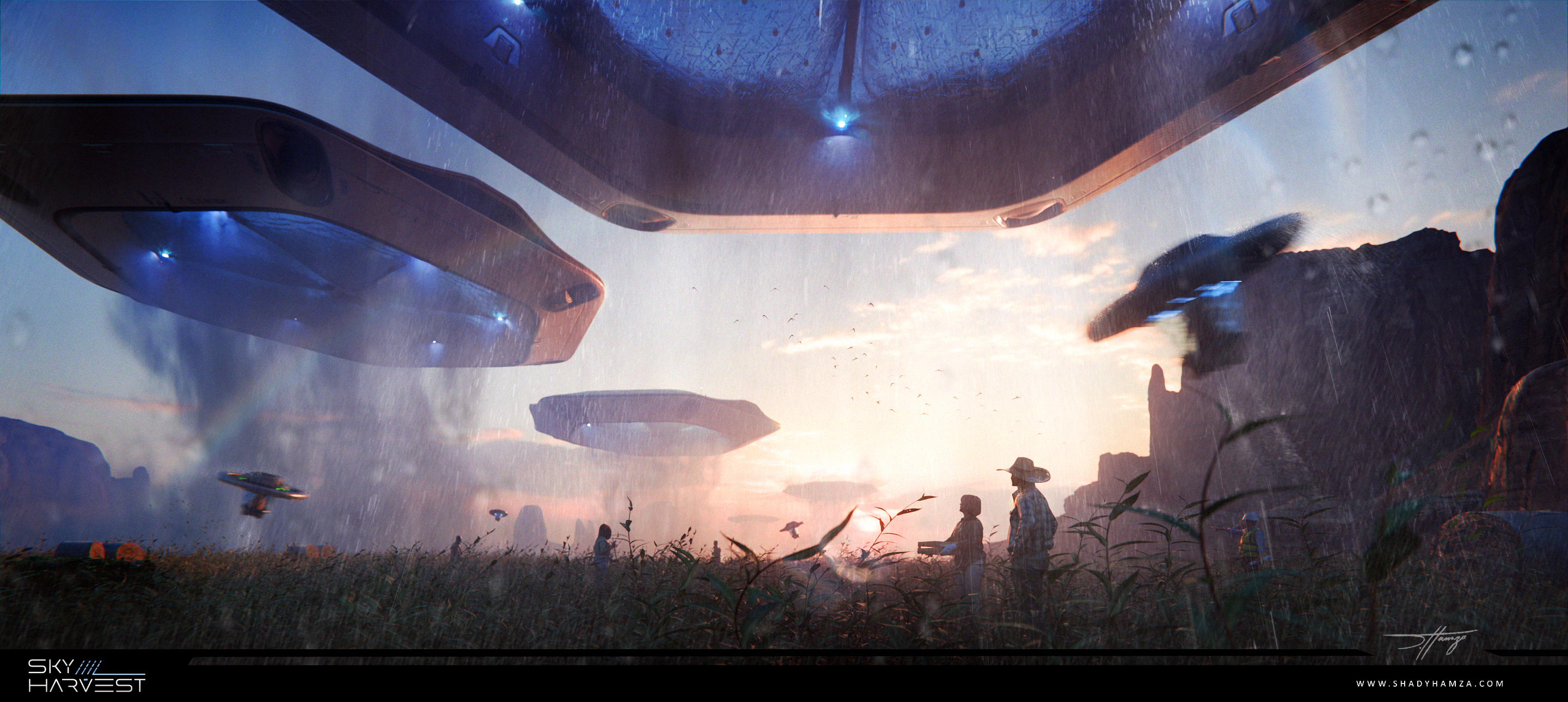
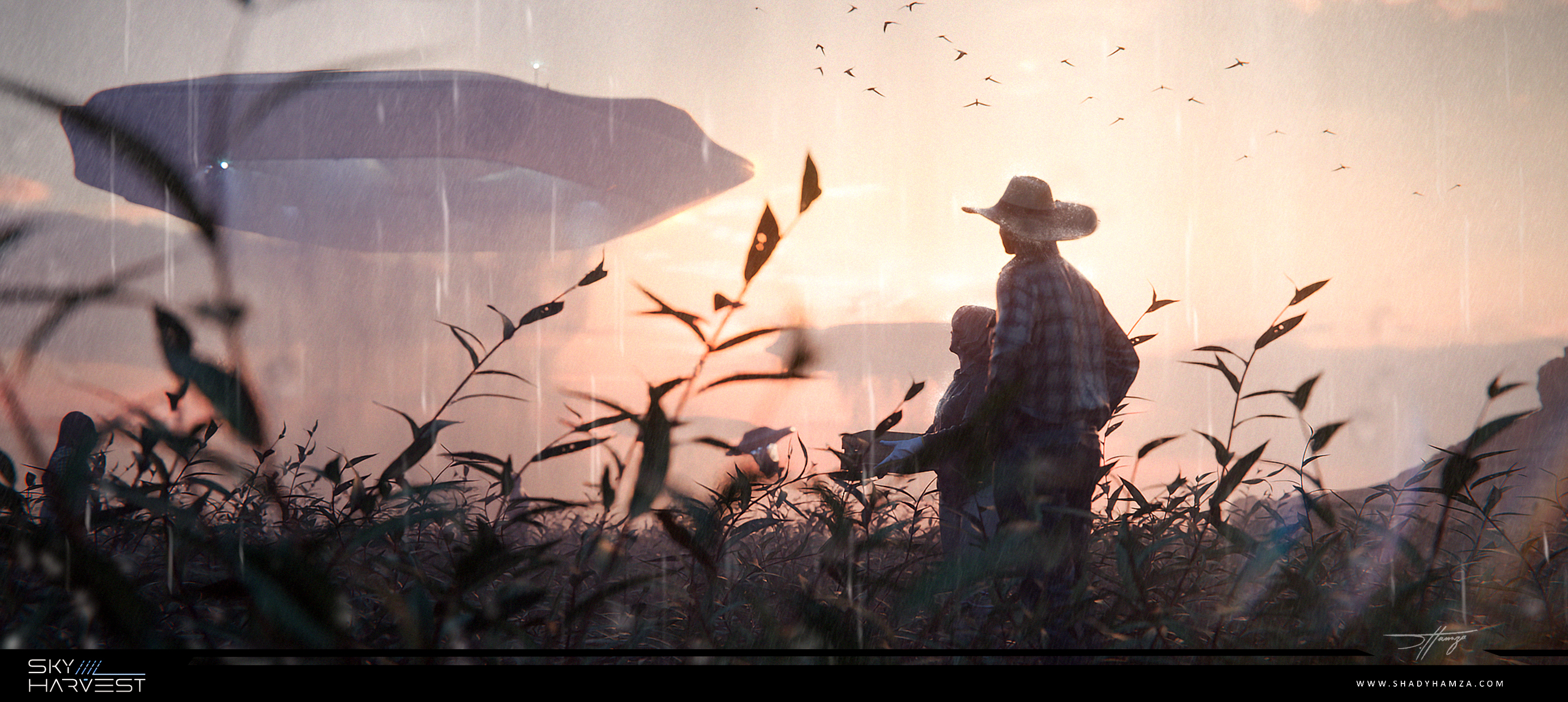
This project envisions a futuristic aerial platform designed to combat desertification by harvesting atmospheric moisture and transforming it into controlled rainfall. Operating as a self-sustaining environmental system, it condenses water, and redistributes it over arid regions to restore ecosystems.
Blending advanced technology with natural processes, the platform creates a controlled water cycle in the sky, reviving depleted landscapes and supporting the return of vegetation. More than infrastructure, it represents a new approach to environmental repair, where innovation actively works to regenerate fragile climates.

☁️Design Logic of Elevation
By operating in the air, the system gains access to:
higher and more stable humidity layers
cooler temperature zones for condensation
uninterrupted airflow patterns for harvesting moisture
Instead of trying to force water into dry ground, the system first intercepts the atmospheric cycle before it reaches the desert surface.
🌍Why Not Ground-Based?
A ground system would face major limitations:
- rapid evaporation due to surface heat
- limited airflow access for moisture collection
- soil instability and erosion constraints
- localized effectiveness only (no regional reach)
🌿Aerial Advantage
By suspending the system above the terrain:
- ☁️ it engages directly with atmospheric moisture flow
- 🌧️ it distributes rainfall downward in controlled patterns
- 🌱 it allows soil recovery to happen gradually and naturally below
- 🔄 it can relocate or scale across regions like a weather system
🌿System Outcome
By continuously introducing small, controlled inputs of water into dry environments, the system:
restores soil moisture balance
enables vegetation regrowth in staged clusters
reduces surface temperature over time through increased plant cover
gradually reverses the conditions that cause desertification
The design functions as a long-term atmospheric repair system rather than a one-time irrigation solution.
🌍Log 01- Concept: Atmospheric Regeneration System
🌱Core Vision
Desertification is the long-term degradation of fertile land into dry, unproductive desert. It is driven by factors such as:
- ☀️ rising temperatures and increased evaporation
- 💨 loss of soil moisture and humidity
- 🌾 vegetation collapse and ecosystem breakdown
- 🧱 soil becoming dry, compacted, and unable to support plant life
Once this cycle begins, the land loses its ability to retain water, making natural recovery extremely slow or impossible without intervention.
🌍Design Response
This system proposes a large-scale atmospheric intervention platform that directly targets the missing resource in desertification: water availability in the air and soil system.
Instead of transporting water externally, the system:
- ☁️ extracts moisture already present in the atmosphere
- 🌧️ converts it into a precipitation shaft over targeted zones
- 🌱 gradually rebuilds soil hydration and biological activity
- 🔄 repeats this cycle across multiple regions over time
The goal is not to fight the desert but to restart the water cycle locally so ecosystems can re-establish themselves naturally.
☁️Why an Aerial System?
The system is designed as an aerial platform rather than a ground-based structure because desertification is fundamentally an atmospheric problem before it becomes a soil problem.
In arid regions:
- 🌬️ most available water exists in the atmosphere as low-density humidity
- 🌡️ extreme ground heat prevents stable moisture retention at surface level
- 🧱 degraded soil cannot reliably store or redistribute water on its own
This means the most accessible “hidden resource” is not underground, it is above the land, in the air layer itself.
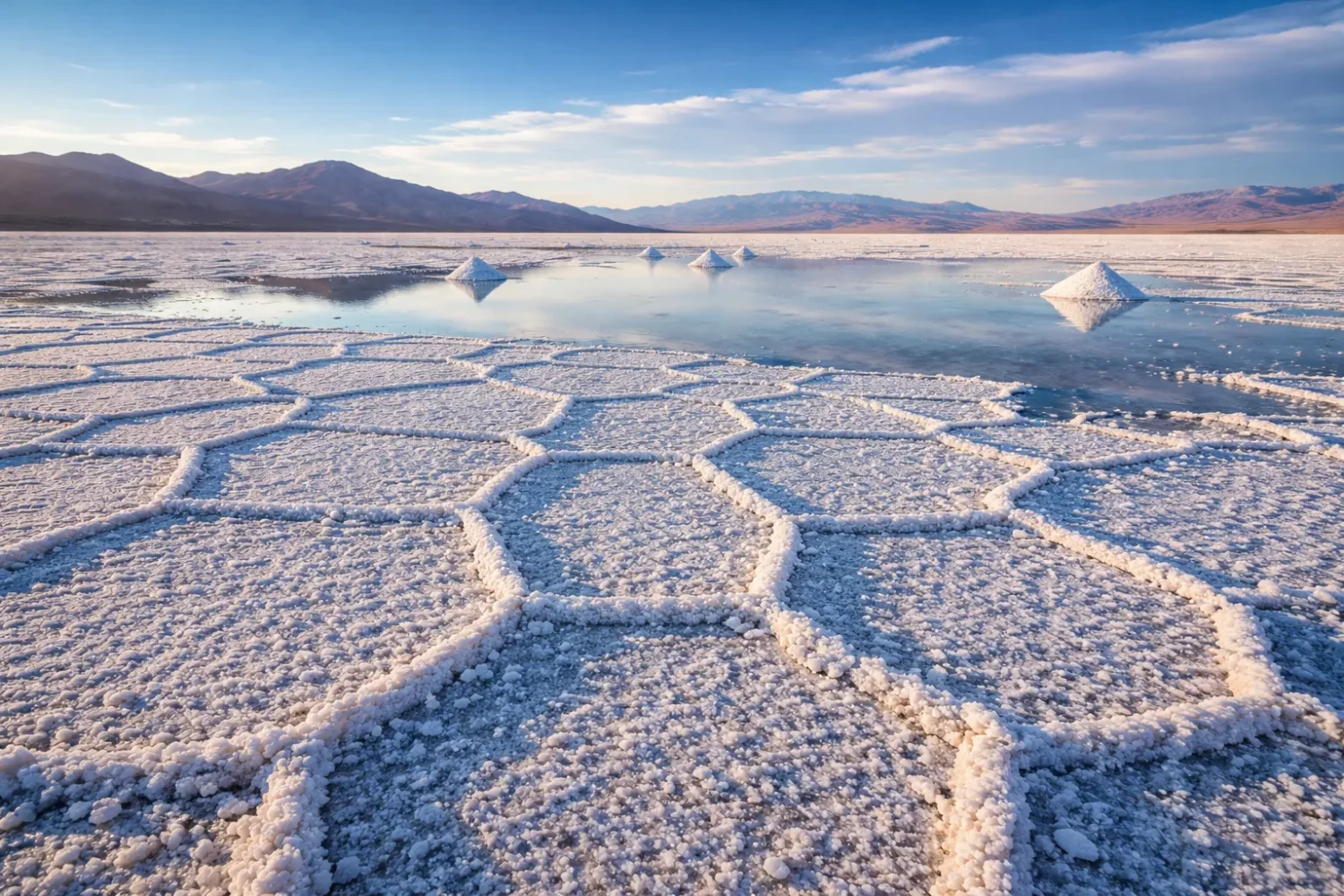
🧩Log 02 - Form Genesis & Footprint: Salt Desert Logic to Soft Hex Torus System
🌊Natural Inspiration: Salt Desert Systems
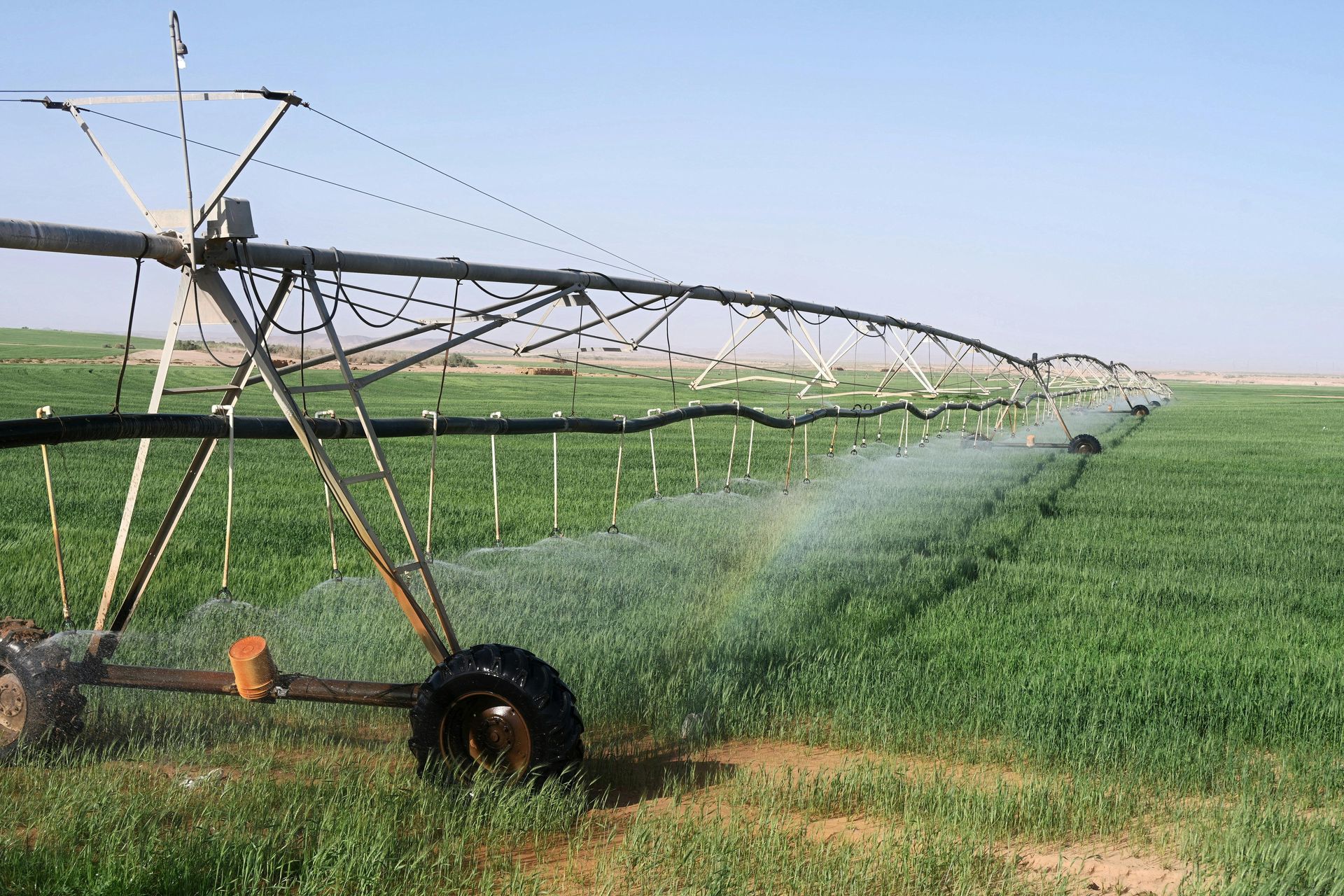
The structural logic is inspired by salt flat polygon patterns. These formations:
emerge from cycles of evaporation and mineral deposition
form large-scale interconnected polygon networks
resemble hexagonal cellular structures
demonstrate how environmental forces naturally generate geometry
This becomes the guiding principle: the system should behave like a landscape that designs itself through environmental interaction
🔷Geometric Evolution: From Hex Grid to Soft Hex Torus
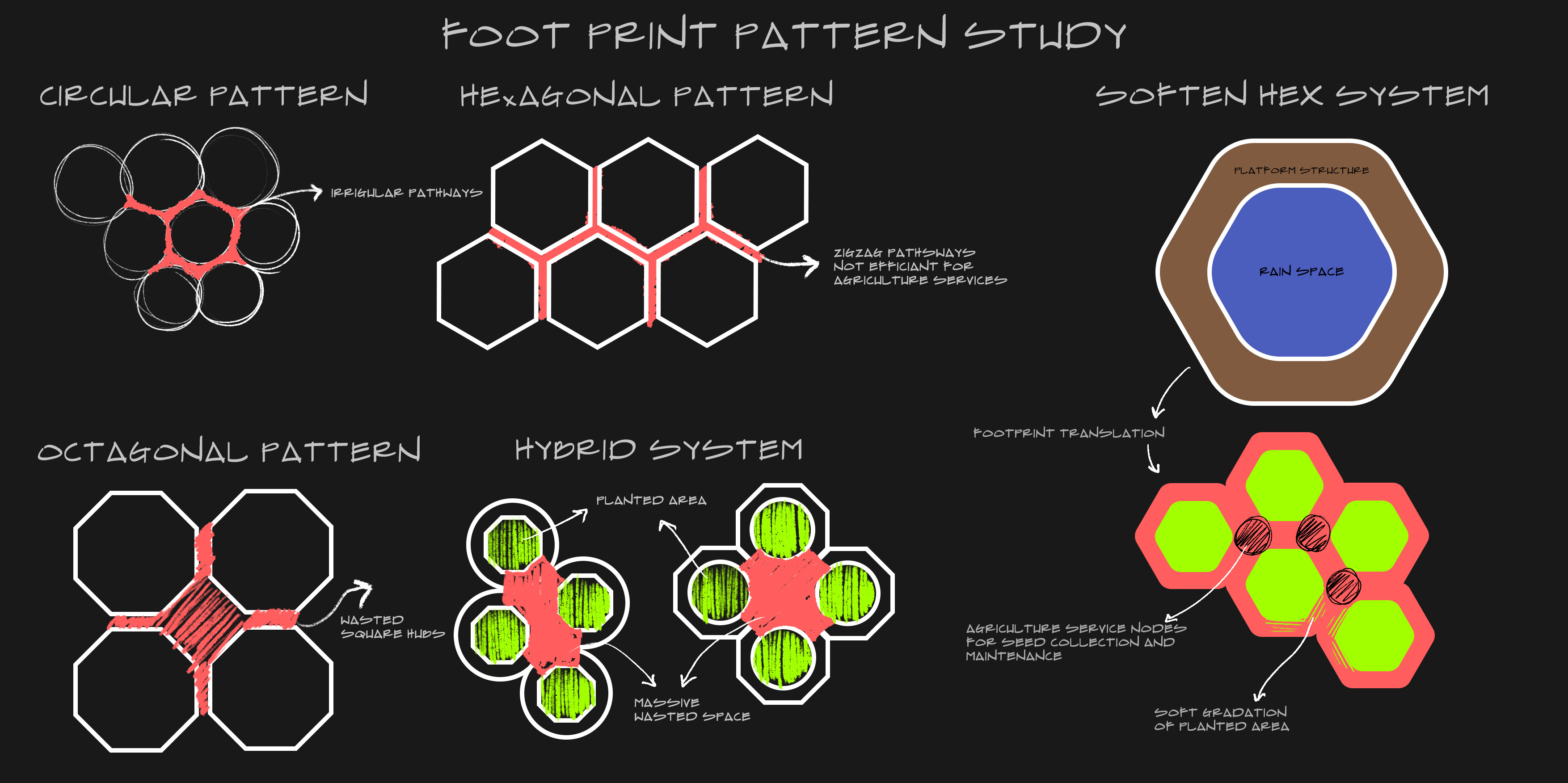
Hexagonal tiling is used as the base modular system due to its scalability and structural efficiency. However, pure hex grids fail in atmospheric conditions because they introduce rigid edges that disrupt airflow, turbulence at edges and rainfall behavior.
To resolve this, the geometry evolves into a soft hex torus:
- hex structure is preserved for tiling and expansion
- edges are softened to allow smooth atmospheric flow
- the center becomes a greenhouse-like condensation chamber
- airflow and moisture circulate continuously rather than stopping at boundaries
This transforms the form from a rigid infrastructure grid into a living atmospheric system.
☁️Atmospheric Function
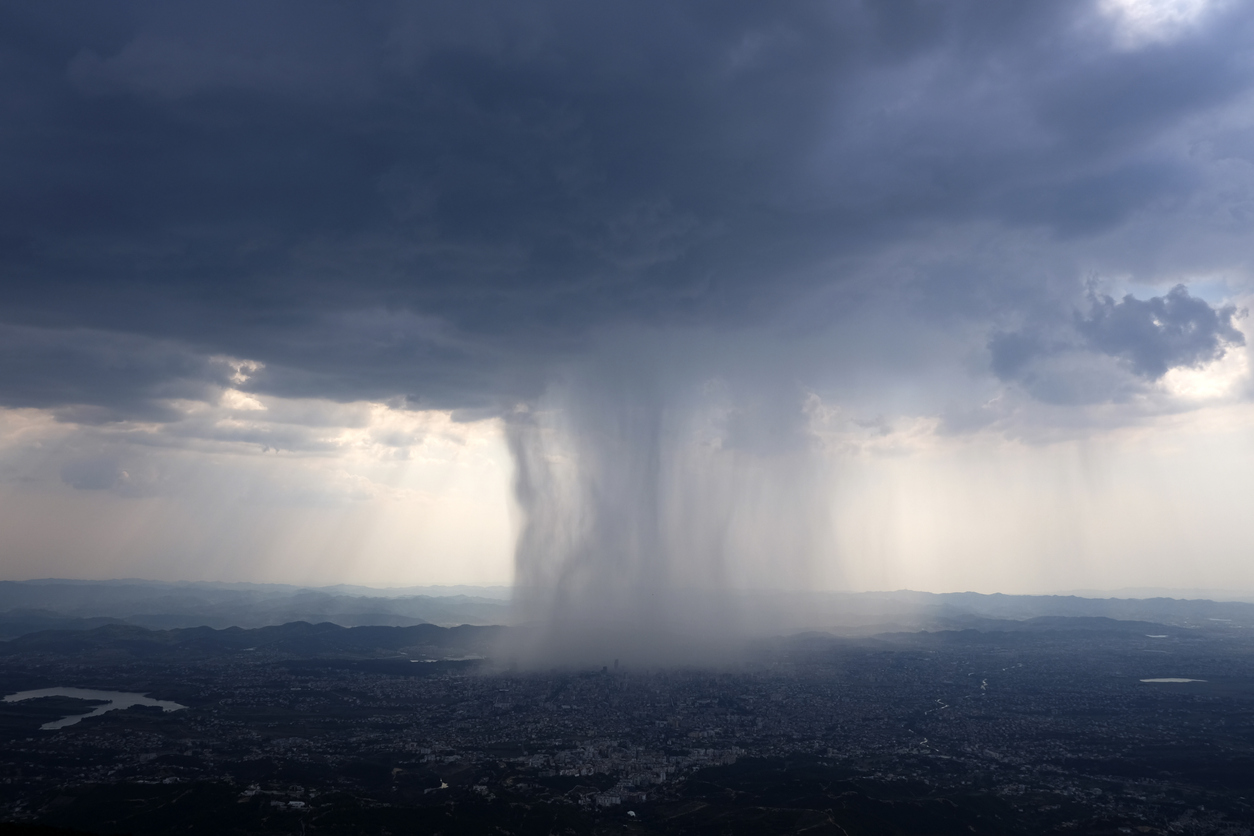
- humid air is drawn into the central chamber
- condensation forms on internal surfaces
- water is stabilized and released through controlled micro-nozzles
- rainfall is distributed in a radial gradient from center outward
This creates a controlled hydrological behavior rather than natural random precipitation.
🧱Footprint Logic: Gradient-Based Land Formation
The system is not only restoring moisture. It is preparing land for:
- 🌾 agriculture
- 🚜 access and movement
- 🏡 service infrastructure
- 🌱 staged ecological recovery
When multiple units are connected, this creates a continuous field of:
- 🌧️ a concentrated rainfall zone at the center
- 🌱 gradual moisture reduction toward the outer edges
- 🚶 natural pathways forming along the driest boundary zones between units
🌿Agricultural & Infrastructure Integration
This gradient allows the land to self-organize into functional zones:
- center → intensive agriculture and high-yield planting
- mid zones → adaptive or mixed cultivation
- edges → movement paths, infrastructure, and service access
Infrastructure does not interrupt ecology, it forms within the low-moisture logic of the system.
🌱Long-Term Ecological Outcome
Over time, repeated rainfall patterns imprint a hydrological memory into the soil:
- vegetation clusters form along moisture gradients
- land use becomes self-organizing
- the geometry disappears visually but remains functionally embedded
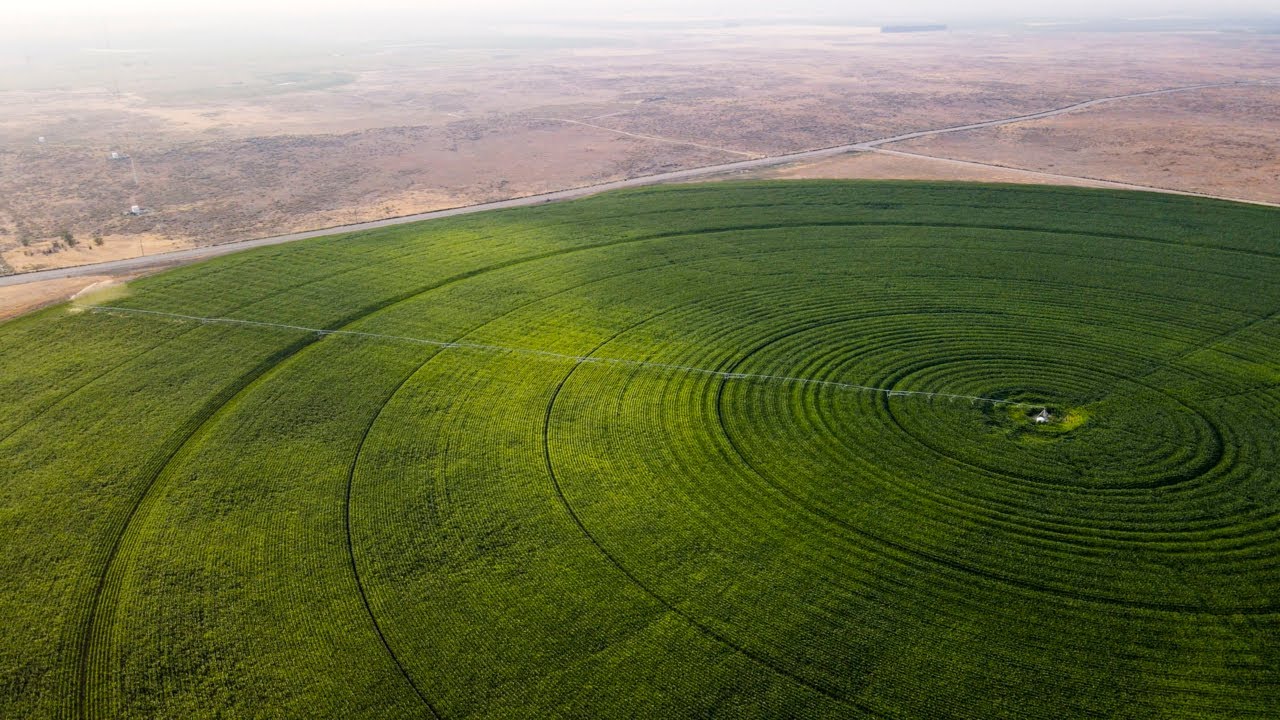
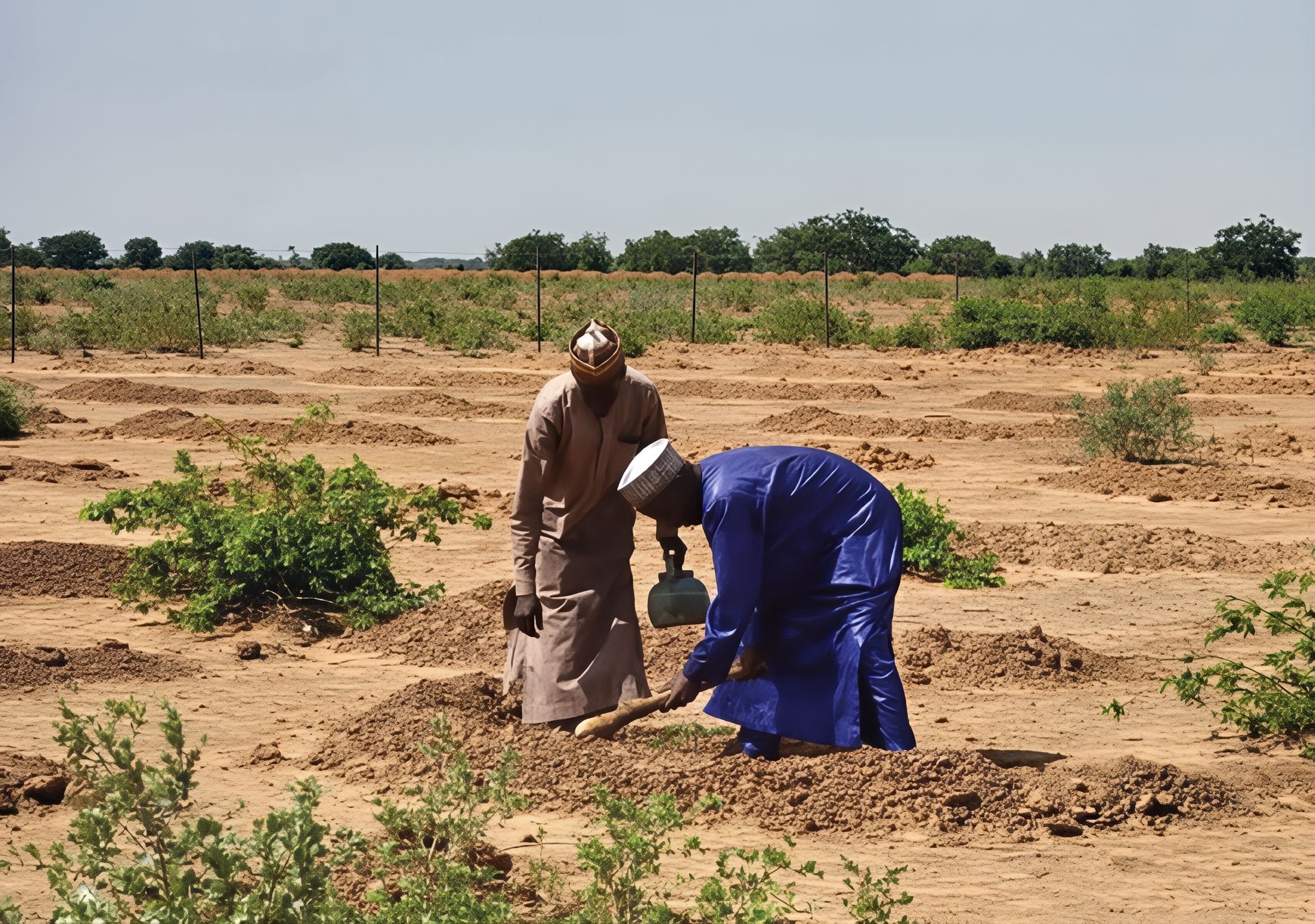
✏️Log 03 - Spatial Blockout & Iterative Surface Mapping
Following the atmospheric strategy and geometric evolution defined in previous logs, this phase translates the system into a spatial blockout model. The objective is not precision, but to establish scale, proportion, and spatial relationships between components before moving into detailed design.
The blockout acts as a bridge between concept and form, a way to test how the atmospheric system occupies space and interacts with airflow, gravity, and terrain below.
⚡ Platform Power & Energy Integration
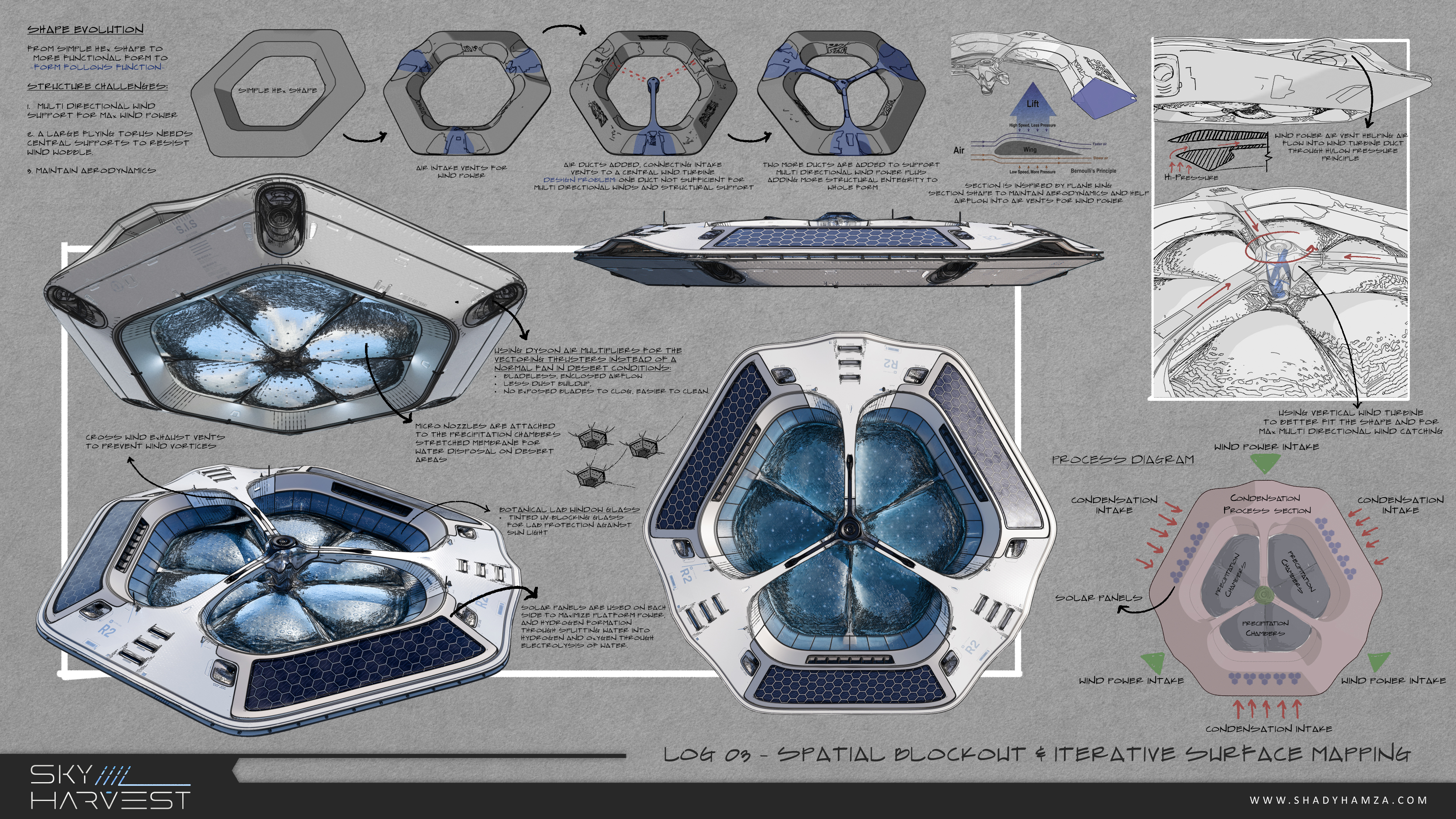
As the spatial blockout stabilizes, the platform begins to incorporate an embedded energy system that supports both its atmospheric function and autonomous operation. Rather than treating power generation as an external layer, it is integrated directly into the geometry and airflow logic of the structure.
🌀 Central Vertical Axis Wind Turbine (VAWT)
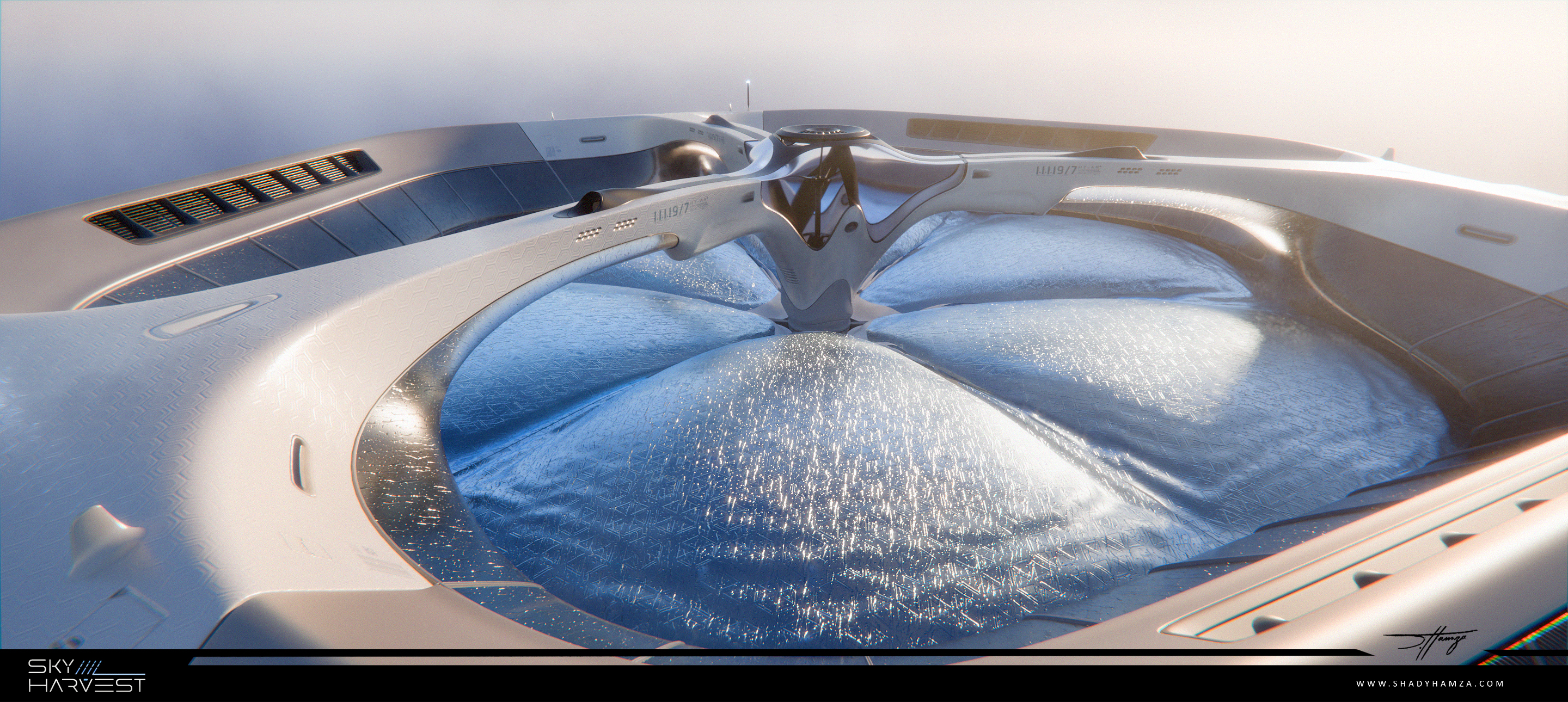
Positioned at the core of the hexagonal platform, a vertical axis wind turbine acts as the primary energy generator. Its placement within the central void aligns with the condensation chamber, allowing it to capitalize on accelerated airflow already being directed through the system. This co-location ensures that energy generation and atmospheric processing reinforce one another rather than compete.
🌬️ Tri-Duct Structural System
The turbine is anchored and stabilized by three radial air ducts extending outward toward the platform edges. These ducts serve a dual purpose:
Structurally, they act as bracing elements, distributing loads across the platform and reducing oscillation or wind-induced wobble.
Environmentally, they channel and compress airflow toward the turbine, increasing efficiency while maintaining controlled air movement through the system.
This creates a feedback loop where airflow strengthens both structural integrity and energy production.
✈️ Aerodynamic Platform Section
The platform itself adopts a wing-like sectional profile, similar to an airfoil. This geometry reduces drag while encouraging smooth airflow across and through the structure. By shaping the platform in this way, wind is naturally guided toward the turbine intake zones and duct openings, enhancing overall system performance without additional mechanical input.
☀️ Distributed Solar Layer
Photovoltaic panels are embedded across the upper surfaces of the hexagonal platform. These panels provide a secondary, consistent energy source that complements the variability of wind. Their distributed placement ensures balanced energy collection while maintaining the readability of the overall form.
The excess energy generated from both wind and solar sources is redirected toward hydrogen production. This introduces a long-term energy storage mechanism that supports the platform’s buoyancy and sustained operation.
This addition keeps your conceptual language intact while clearly explaining how energy, structure, and airflow all reinforce each other.
🌫️ Perimeter Intake & Condensation Flow
The condensation process begins at the outer edge of the platform, where air is passively absorbed through a continuous band of porous mesh integrated into the perimeter. Rather than relying on forced intake, this strategy leverages pressure differentials created by the platform’s aerodynamic form and the central turbine system.
🌬️ Mesh Intake Layer
The perimeter mesh acts as a breathable boundary, allowing humid air to enter while filtering particulates and slightly diffusing airflow. Its distributed nature ensures that intake occurs evenly across the platform, preventing localized turbulence and maintaining a stable inflow.
❄️ Guided Cooling Pathways
Once inside, the air is funneled through internal channels where its velocity is regulated and temperature gradually reduced. This cooling phase is essential, it slows the air mass and increases relative humidity, preparing it for condensation. The previously defined duct network contributes here by maintaining directional flow toward the core.
🌀 Precipitation Chamber Transition
As the air converges toward the central recessed volume, it reaches the precipitation (condensation) chamber. By this point, the air has been sufficiently cooled and compressed, allowing moisture to condense into droplets. The torus-like geometry encourages circulation, maximizing contact time and improving overall efficiency of the phase change.
🌧️ System Continuity
This perimeter-to-core flow establishes a continuous atmospheric cycle:
intake → cooling → condensation → distribution.
Each stage is spatially embedded within the blockout, reinforcing the idea that form, performance, and environmental interaction are inseparable.
🌀 Perimeter Flow Control Units
Peripheral maneuvering is achieved through bladeless air-multiplier thrusters "Dyson technology" positioned at each corner of the platform. This approach minimizes exposure to sand and reduces clogging risks, while maintaining smooth, controlled airflow for directional stability.
Reduced clogging risk → no exposed blades at the intake edge
Smoother airflow → less turbulence, better integration with your aerodynamic platform
Safer + more durable → especially in sand-heavy conditions
✏️ Surface Sketching: Drawing Over Form
Instead of refining geometry directly, sketching is layered over the blockout model, that was modeled in Blender.
This allows rapid exploration of:
- airflow direction and turbulence zones
- water collection paths and condensation
- rainfall dispersion patterns
- transitions between solid structure and porous surfaces
The sketches function as dynamic annotations rather than final design decisions, capturing environmental behaviors and performance considerations before committing to detailed geometry.
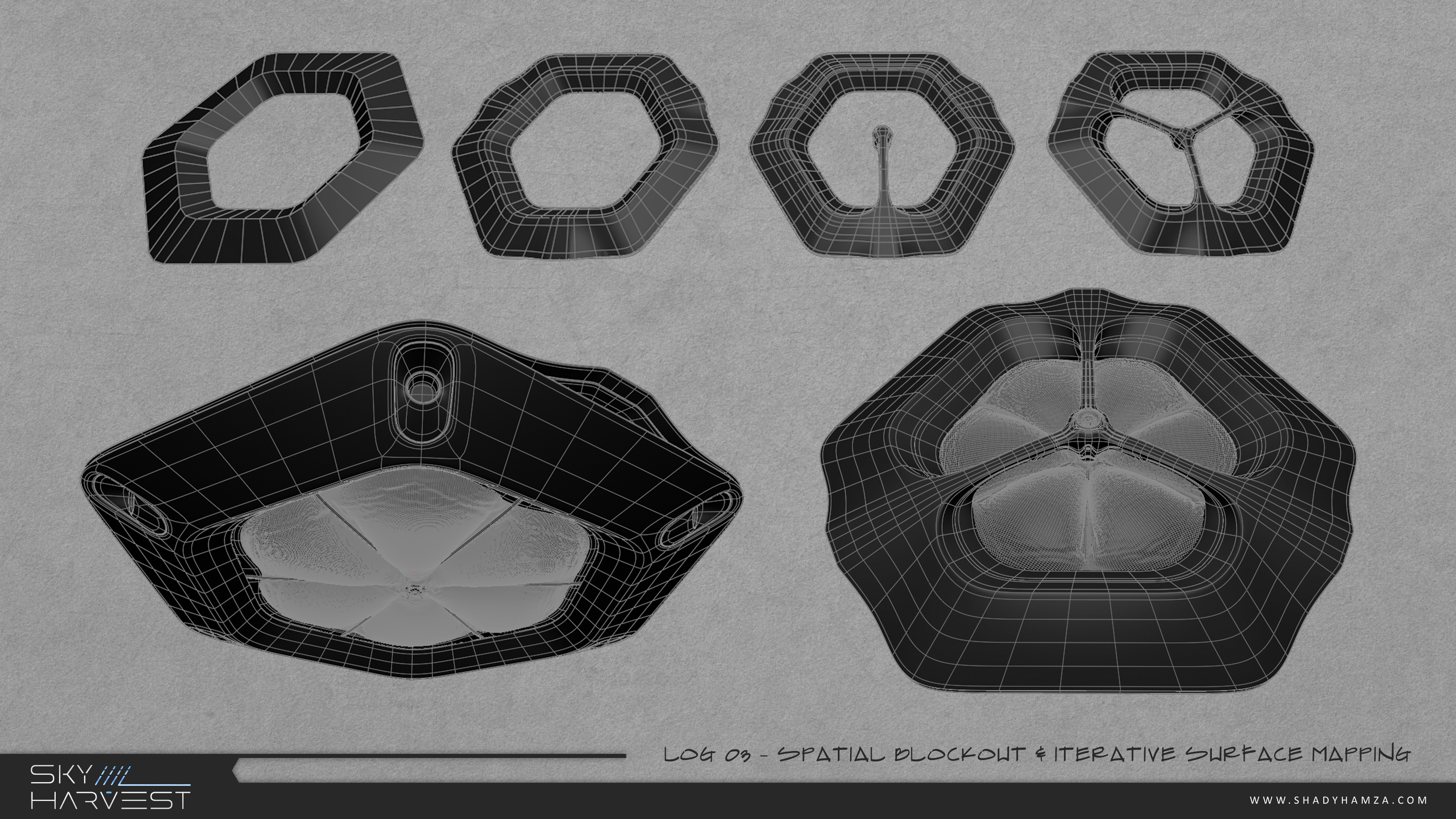

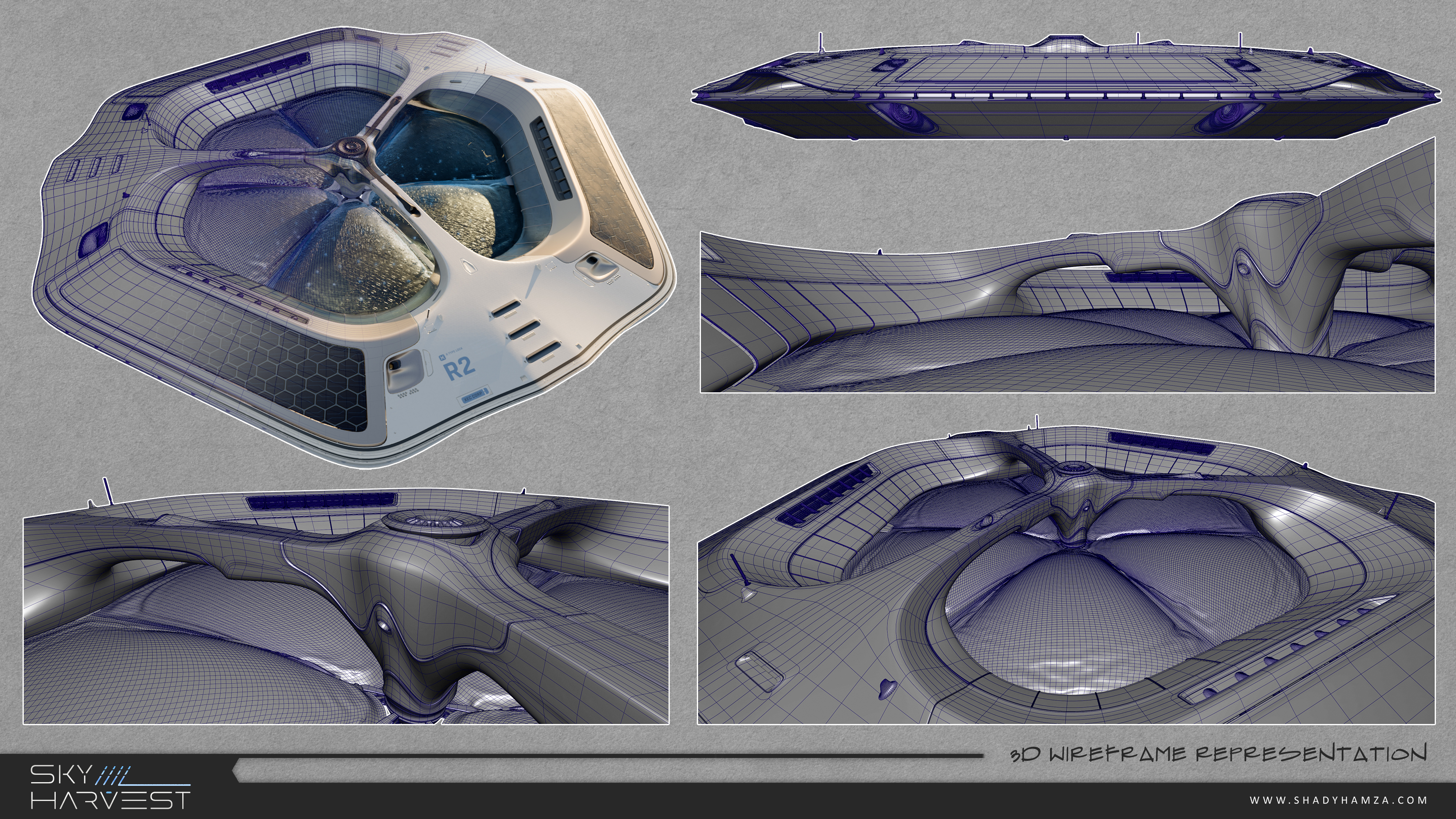
Following the sketching phase, the platform model was further developed with final geometric details, refining structural components and surface features. Once the modeling stage was complete, the asset was UV unwrapped and prepared for texturing.
Texturing was carried out in Substance Painter, where materials were applied and additional surface information was introduced through decals and normal map details. Elements such as hatches, bolts, panel seams, and other mechanical features were added to enhance realism and reinforce the platform’s industrial design language without increasing geometric complexity.
⚛️Log 04 - Hydrogen as Core Lift System
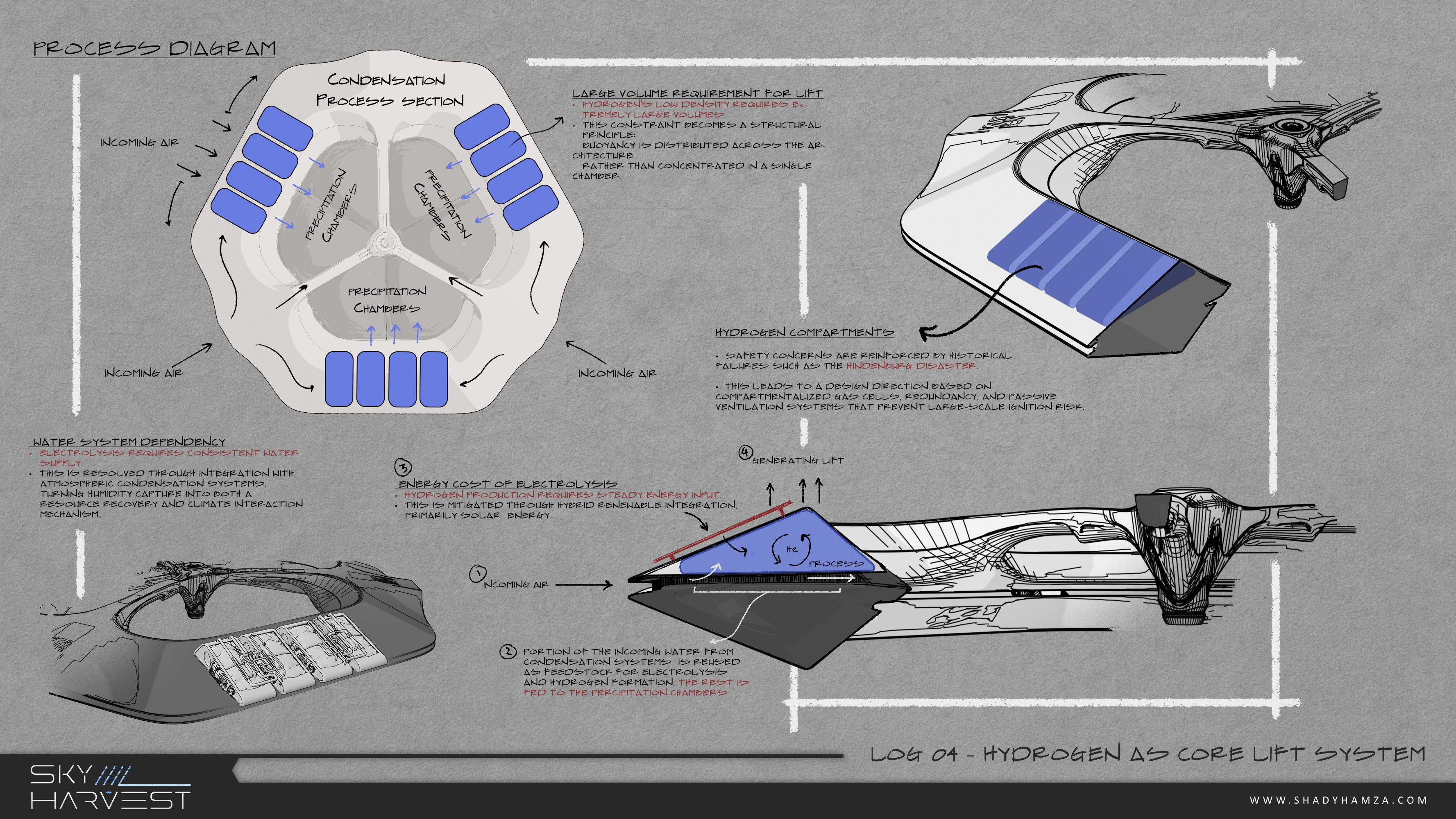
The appeal of hydrogen lies in its compatibility with solarpunk principles of regeneration and self-sufficiency. Unlike helium, which requires external extraction and supply chains, hydrogen can be produced on-site through solar-powered water electrolysis. This immediately reframes lift as a continuously regenerated process rather than a stored resource. Sunlight becomes the primary driver of a loop that links water, air, and energy into a closed system.
At this point, hydrogen is no longer understood only as a lifting gas. It becomes a carrier within a larger atmospheric metabolism: water is split into hydrogen and oxygen, hydrogen provides buoyant lift, and the system continuously interacts with ambient humidity. This transforms the concept into something closer to an environmental machine than a static structure.
A key realization emerges here: hydrogen production does not only consume water, it can actively participate in water redistribution strategies relevant to desertification.
The final conceptual shift reframes the system not as a floating or aerial platform, but as a self-regulating atmospheric infrastructure. Hydrogen enables lift, but also anchors the logic of water recycling, condensation harvesting, and localized desertification mitigation. In this model, atmospheric moisture is not just collected, it is actively shaped, redistributed, and cycled through the system.
💦Integrated Water & Atmospheric Function
The electrolysis process inherently separates water into hydrogen and oxygen. While hydrogen is retained for lift, the oxygen byproduct is released into the system or surrounding air, contributing to localized atmospheric enrichment. More importantly, the entire cycle becomes tied to a broader water strategy:
- Incoming water from condensation systems and atmospheric harvesting is reused as feedstock for electrolysis
- Hydrogen lift maintains elevation, placing the system in cooler, higher-altitude air layers where condensation efficiency improves
- Elevated positioning enhances temperature differentials, increasing dew formation on structural surfaces
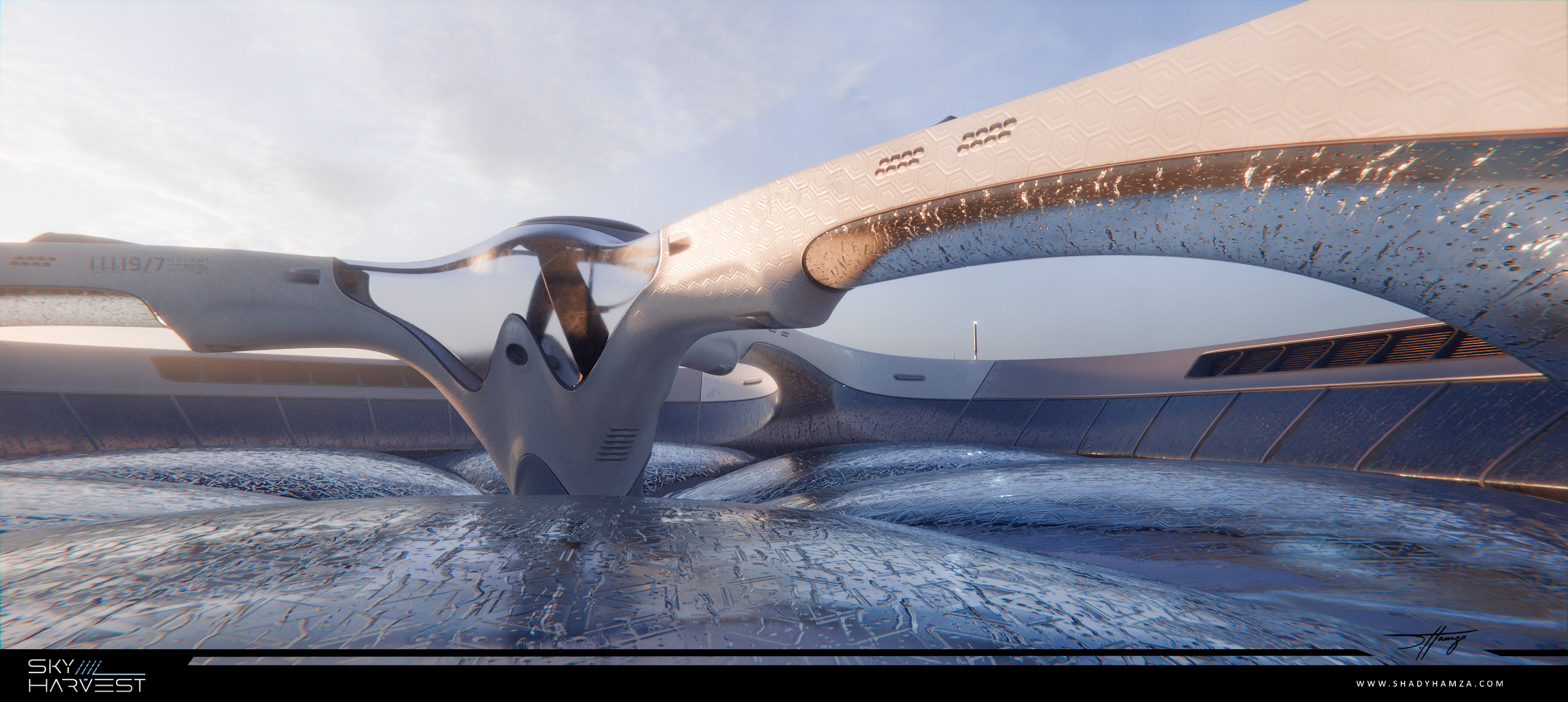
📸Log 5: Platform Beauty Renders
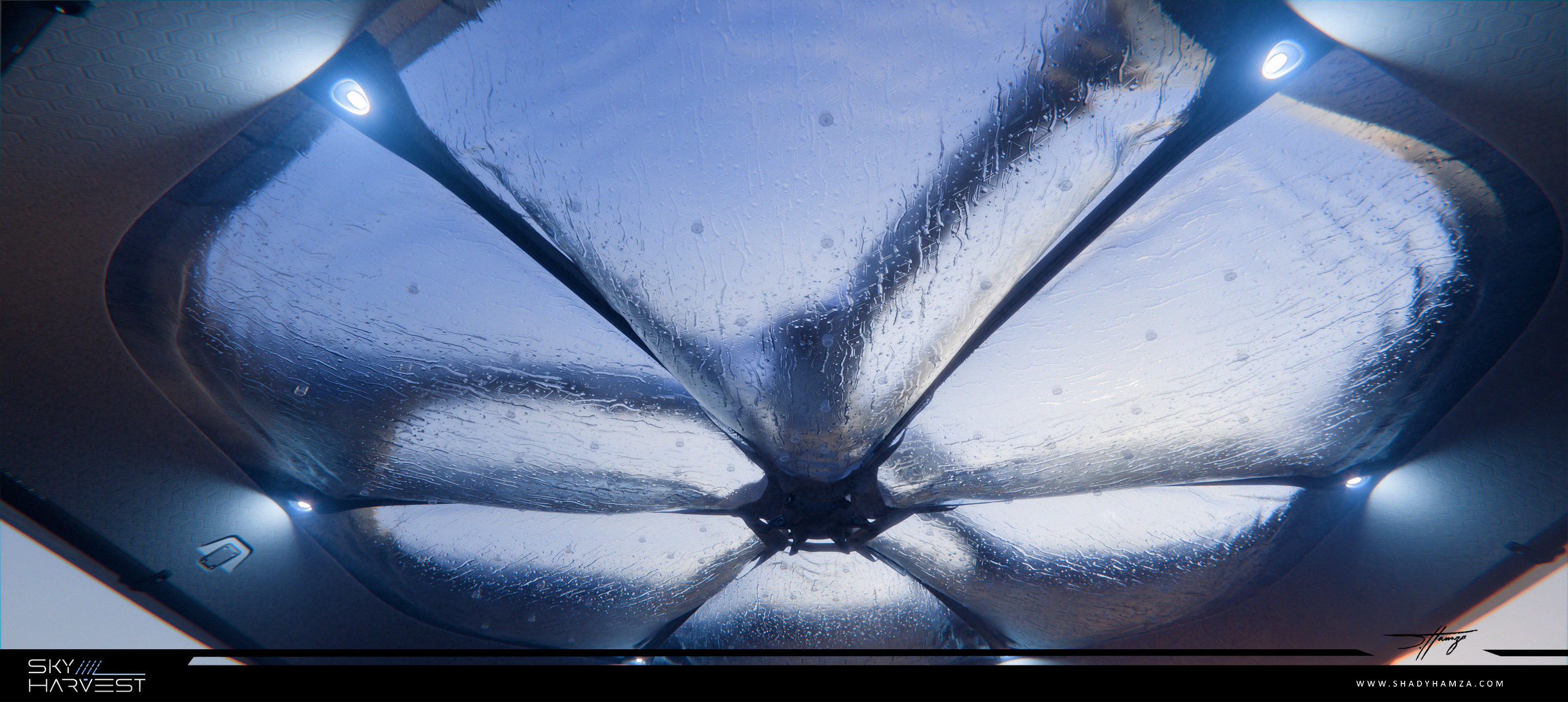
Following the completion of the platform model, a series of beauty renders were produced to showcase the asset within its intended environmental context. These renders focused specifically on the platform, highlighting the final modeling, texturing, and detailing work developed throughout the production process.
The primary objectives of the renders were to:
- Present the completed platform asset in a realistic setting
- Communicate the scale and visual presence of the structure
- Showcase the final materials, textures, and surface detailing
- Demonstrate how the platform interacts with its surrounding environment
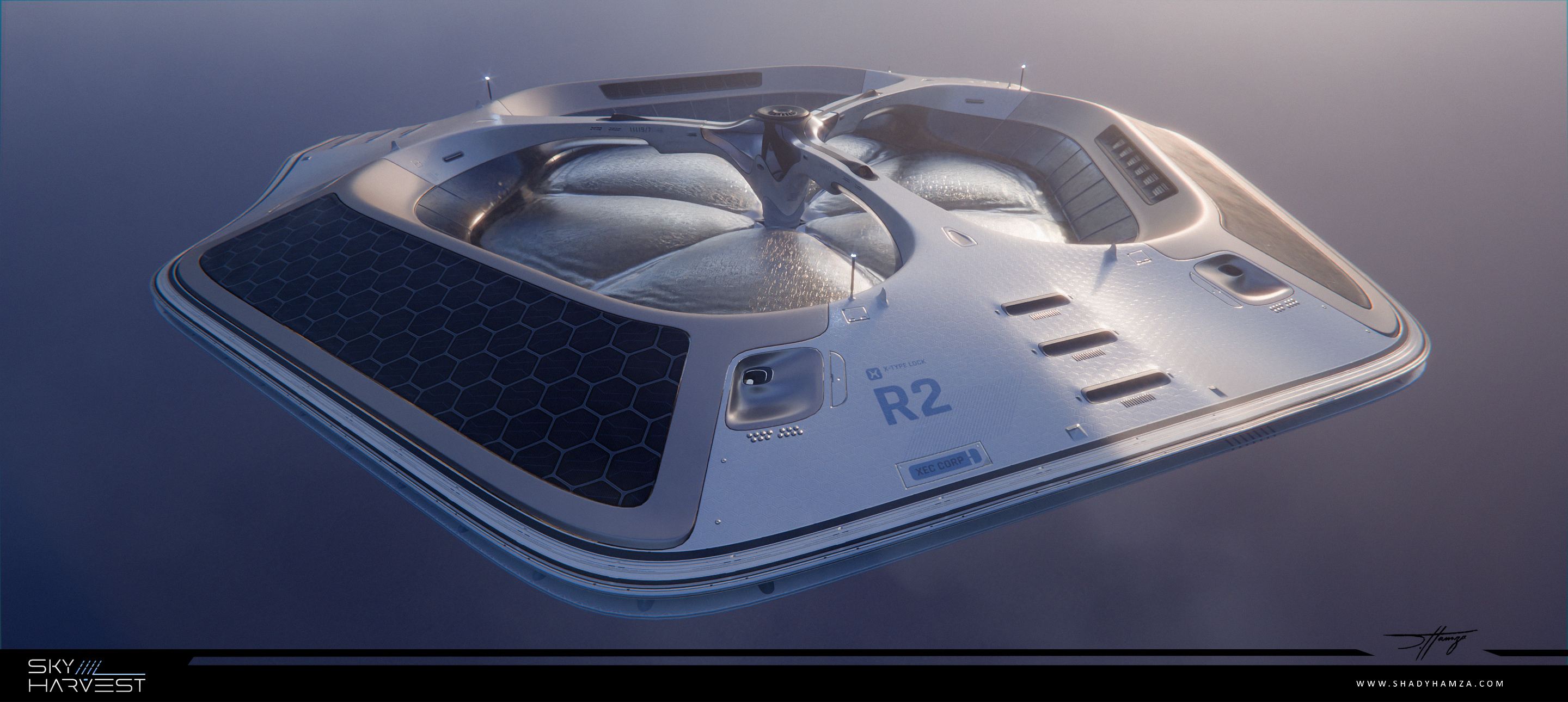
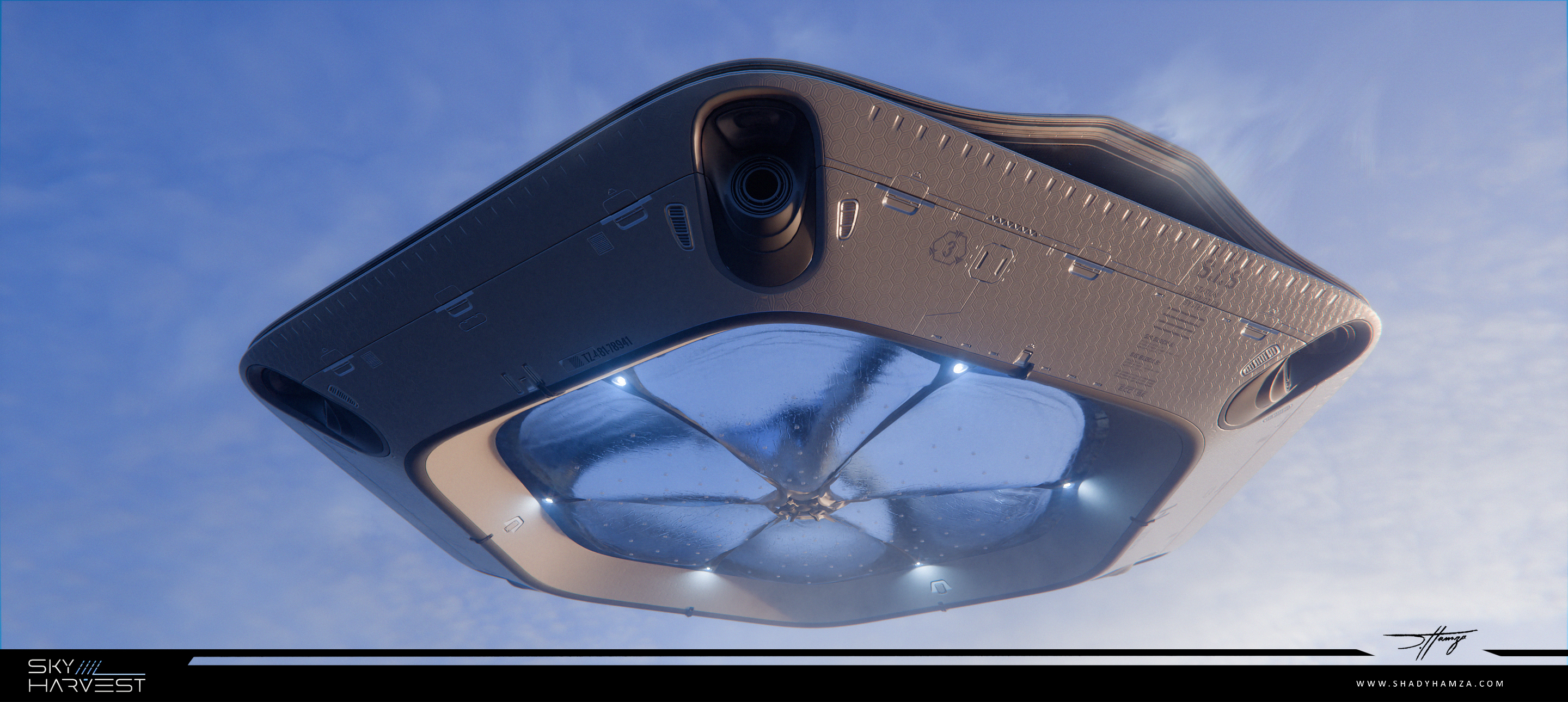
Positioning the platform within a sky-based environment helped reinforce its intended role and relationship with the atmosphere. Rather than relying solely on technical model views, the renders provide a more immersive representation of the design and its operational context.
Particular attention was given to showcasing:
- Decals and graphic markings
- Panel seams and structural segmentation
- Hatches, bolts, and mechanical details
- Material variation and surface wear
- Silhouette and overall form language
Careful consideration was also given to lighting, composition, and camera placement. Different viewpoints were selected to highlight both large-scale design decisions and smaller surface details, ensuring that the platform could be clearly understood from multiple perspectives.
These beauty renders serve as the final presentation stage for the platform asset, bringing together the outcomes of the modeling, UV mapping, and texturing workflows into a cohesive set of images suitable for documentation, review, and portfolio presentation.
🌱Log 06 - Central Retractable Soil Enhancement Drone
🌍 Role Within the Atmospheric Regeneration System
The aerial platform reintroduces rainfall and moderates local climate, but water alone is not enough to reverse desertification. Severely degraded soils often lack:
- Organic matter,
- Microbial life,
- Nutrients,
- and seed banks capable of restarting vegetation.
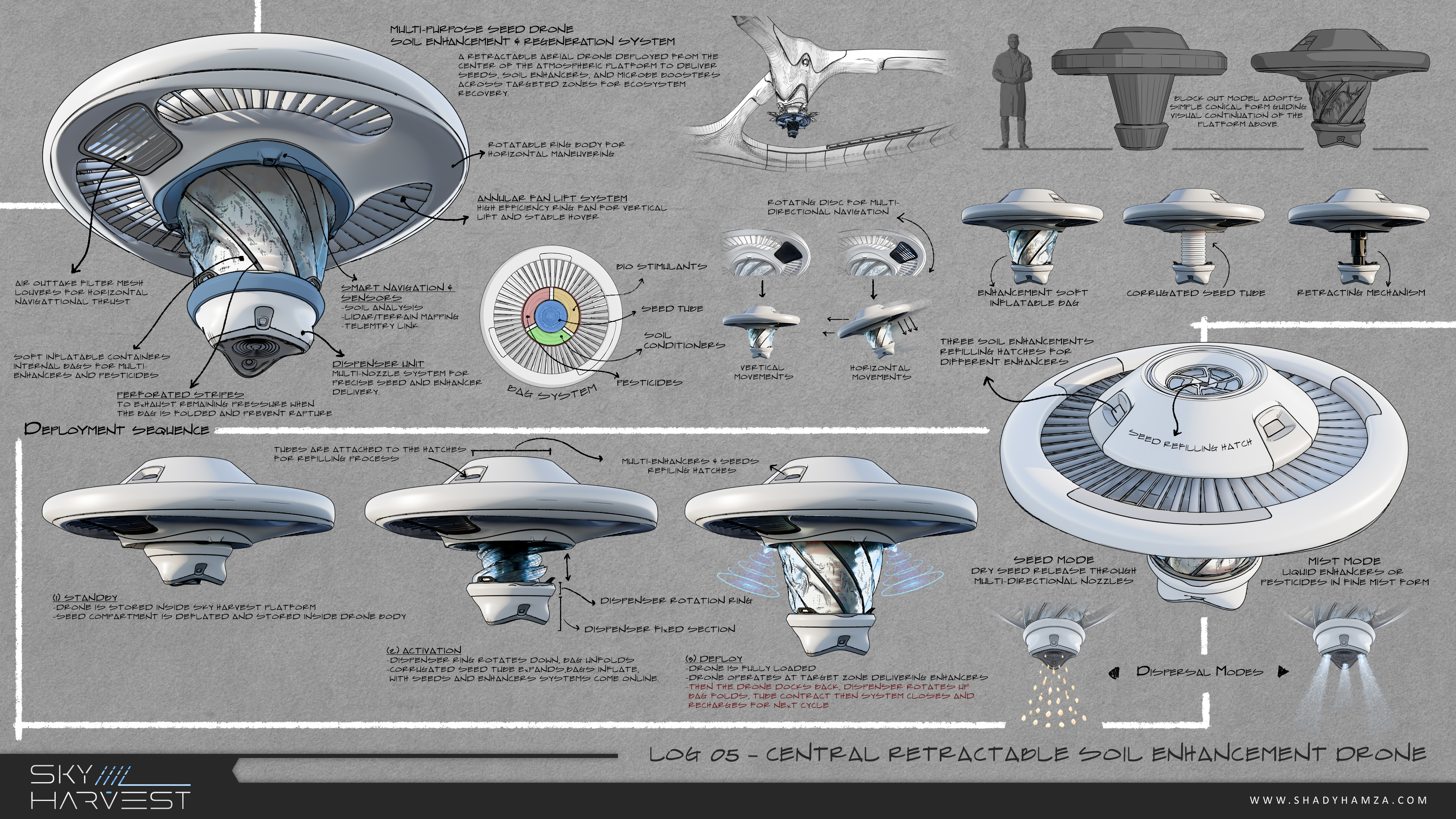
To address this, the platform deploys a retractable multifunctional seed drone from the central underside of the aerial platform, that descend from the structure and perform targeted soil restoration.
This aligns the drone with the core structural axis of the project. Positioned directly beneath the Wind Turbine, the drone becomes an extension of the platform’s central environmental logic. Rather than operating as an independent machine, the drone functions as a detachable ecological tool integrated into the platform’s internal metabolism.
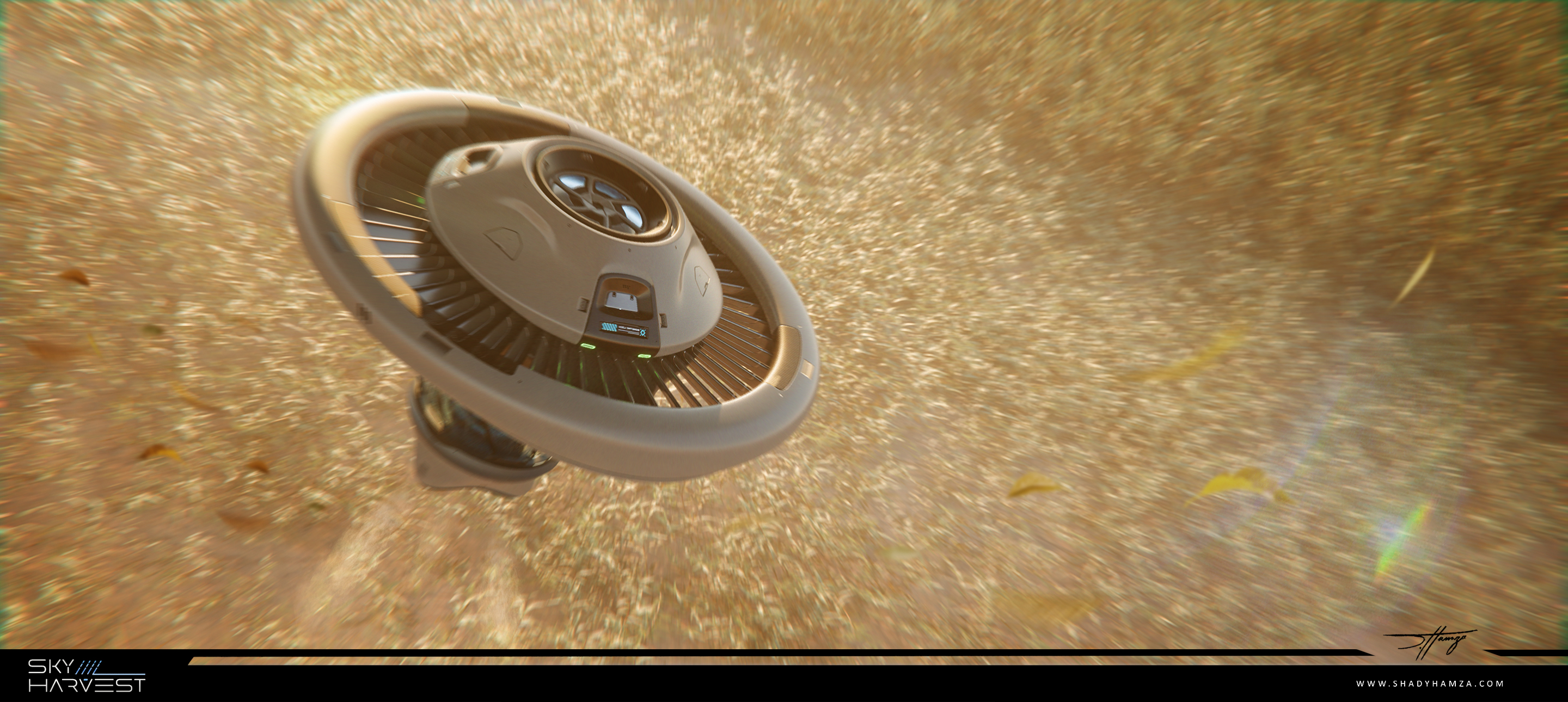
🌱 Tapered Payload Chamber
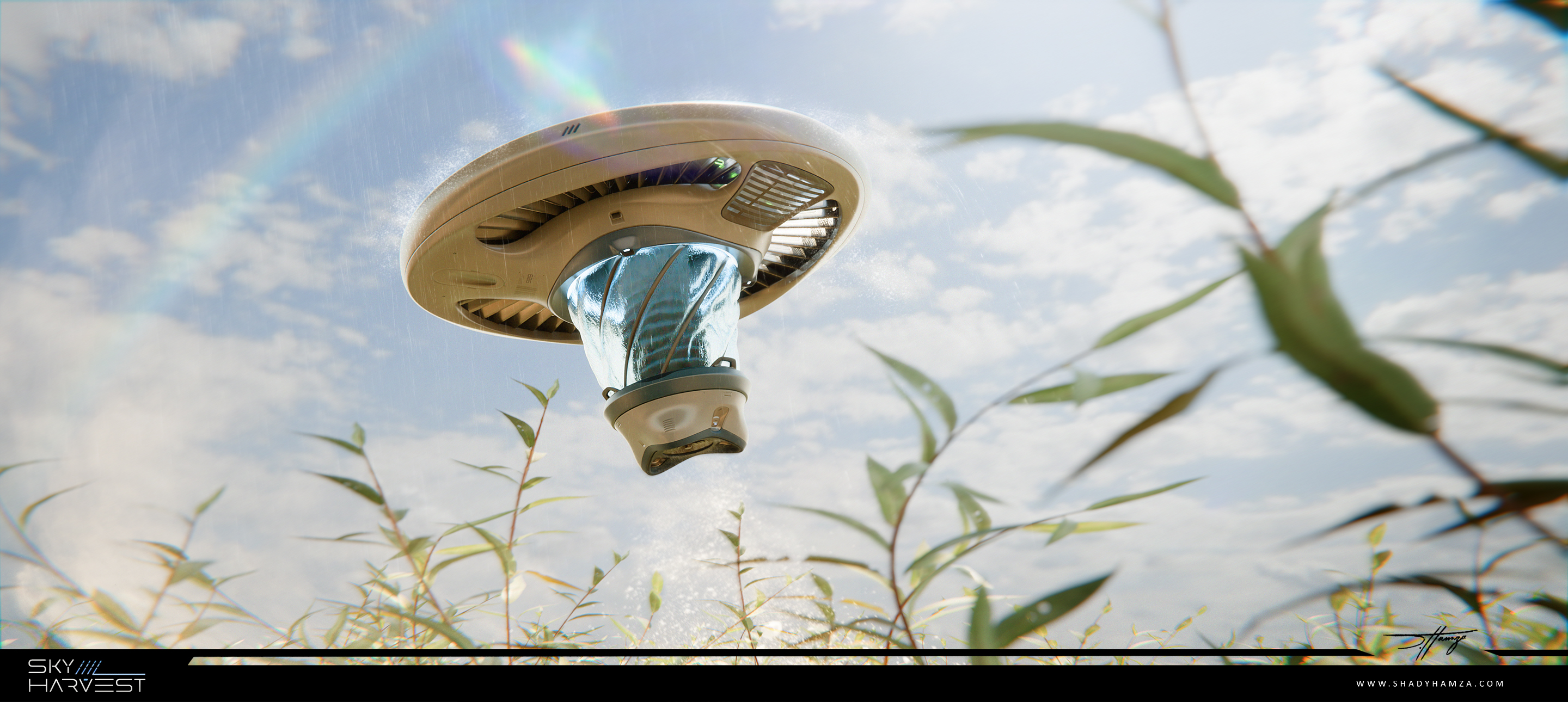
Suspended beneath the fan assembly is a translucent tapered body that functions as the primary payload chamber. The narrowing geometry visually expresses the concentration of materials toward the dispensing point while reducing weight and maintaining balance during flight.
At the center of this chamber is a rigid refillable seed tube that stores native and climate-adapted seeds. Encircling the seed tube is a segmented soft-bag reservoir system. These flexible internal bladders are divided into isolated compartments capable of carrying multiple treatments simultaneously, including:
- microbial cultures,
- nutrient solutions,
- natural biostimulants,
- and targeted pesticides or biological pest controls.
Spiral reinforcement bands around the outer shell stabilize the structure and guide the eye downward, emphasizing the movement of materials from storage to release. As the materials are dispensed, the flexible compartments collapse, minimizing unused volume and improving weight efficiency.
💧 Precision Dispensing Nozzle
At the base of the drone, the tapered chamber transitions into a rounded dispensing head. This lower module concentrates all outputs into a single precision delivery point positioned close to the soil surface.
The nozzle can:
- release seeds,
- spray protective treatments,
- and apply localized amendments.
Its protected geometry reduces clogging while allowing accurate placement under windy desert conditions.
🔄 Central Docking and Refill Cycle
The drone remains docked within the platform’s central bay when not in use. In this stored position, it is visually nested within the underside of the atmospheric structure, preserving the aerodynamic profile of the platform.
After each deployment cycle, the drone returns to the docking chamber where it undergoes automated servicing:
- seed tube refilling,
- reservoir replenishment,
- battery charging,
- dust removal,
- and system diagnostics.
This process allows continuous operation without manual intervention.
🌀 Upper Annular Fan Assembly
The upper disc contains a recessed annular fan integrated within a smooth circular housing. Radial vanes are protected inside the outer ring, shielding the propulsion system from dust and sand while maintaining a clean aerodynamic profile.
Unlike exposed propellers, the annular fan provides:
- stable vertical lift,
- precise low-altitude hovering,
- reduced turbulence,
- and improved durability in desert conditions.
Its toroidal geometry mirrors the soft hex-torus logic of the main platform, reinforcing formal continuity between the mothership and the deployable system.
🛸 Deployment Strategy
The drone is housed within the central docking bay at the lowest point of the platform, directly below the Wind Turbine chamber.
Its deployment sequence is:
- 🌧️ Rainfall is released over the target area.
- ⏳ Soil moisture begins to stabilize.
- 🛸 The drone descends vertically from the central bay.
- 🌱 Soil enhancement and seeding operations are performed.
- 🔋 Payloads are refilled and batteries recharged after return.
- 🔄 The drone docks and becomes part of the platform again.
This central deployment reinforces the idea that all environmental processes radiate from a single atmospheric core.
🛸 Morphological Integration
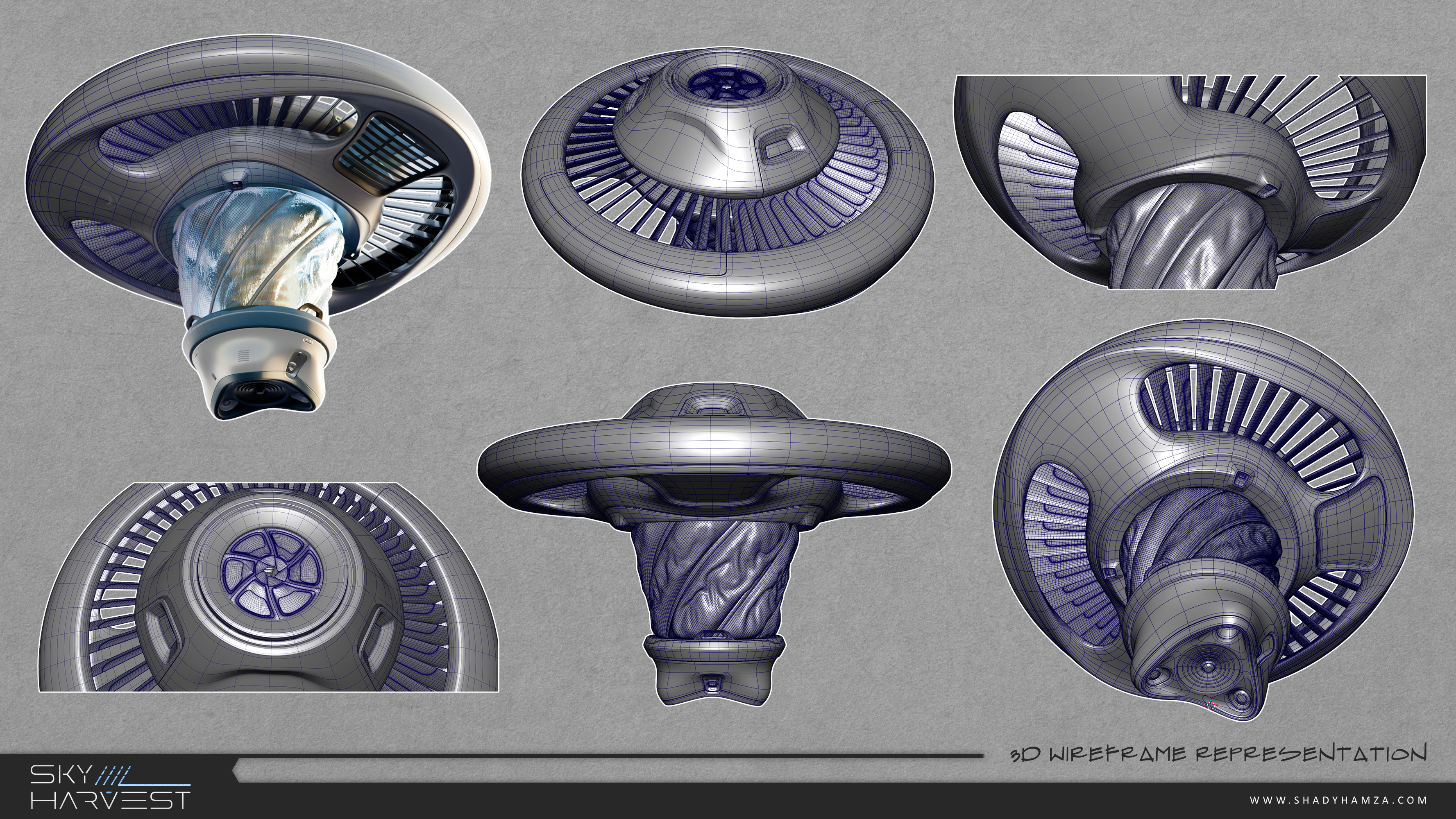
As shown in the development model, the drone adopts a compact, symmetrical form composed of three clearly legible components:
- a circular annular fan housed within a shallow disc-shaped body,
- a tapered central payload module,
- and a rounded dispensing tip at the lowest point.
This configuration creates a direct visual and functional continuation of the platform above. The drone appears less as an attached machine and more as a deployable organ of the atmospheric system itself.
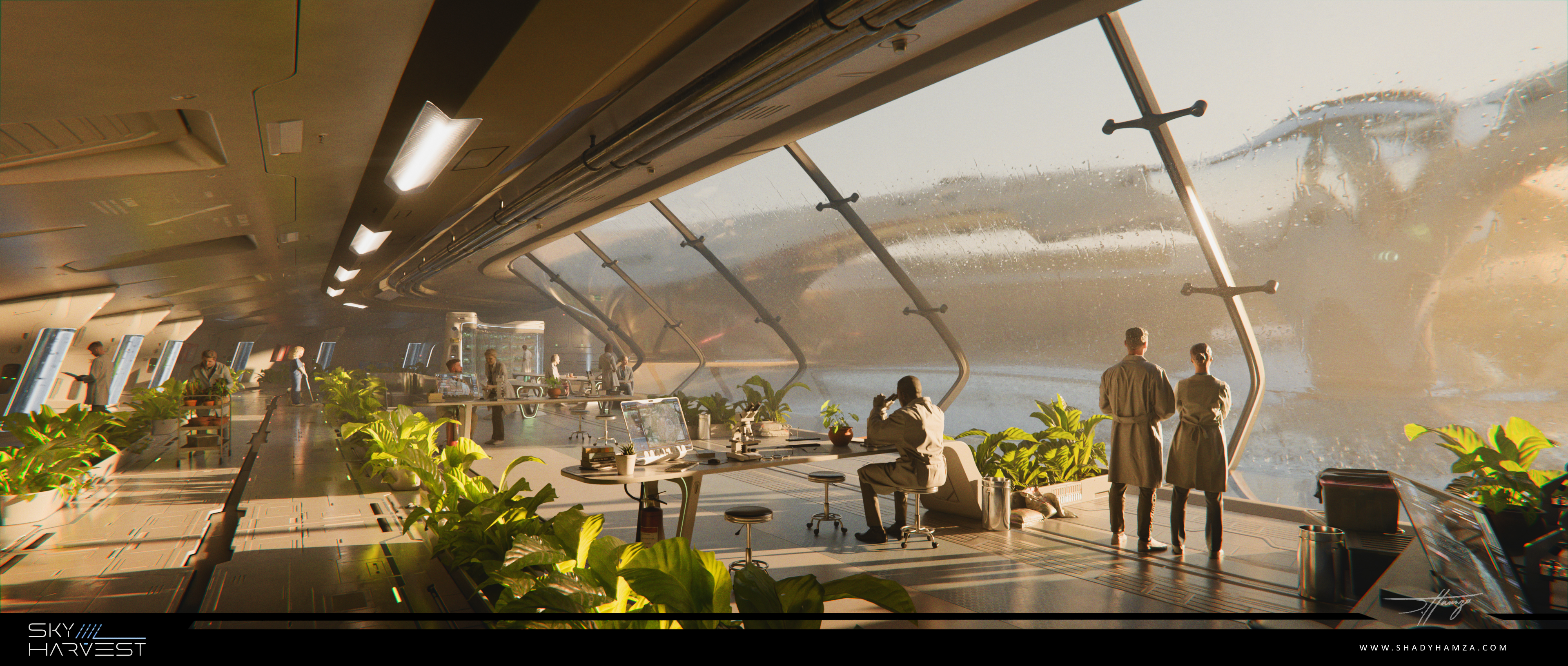
🧪Log 07 - Integrated Botanical Research Core
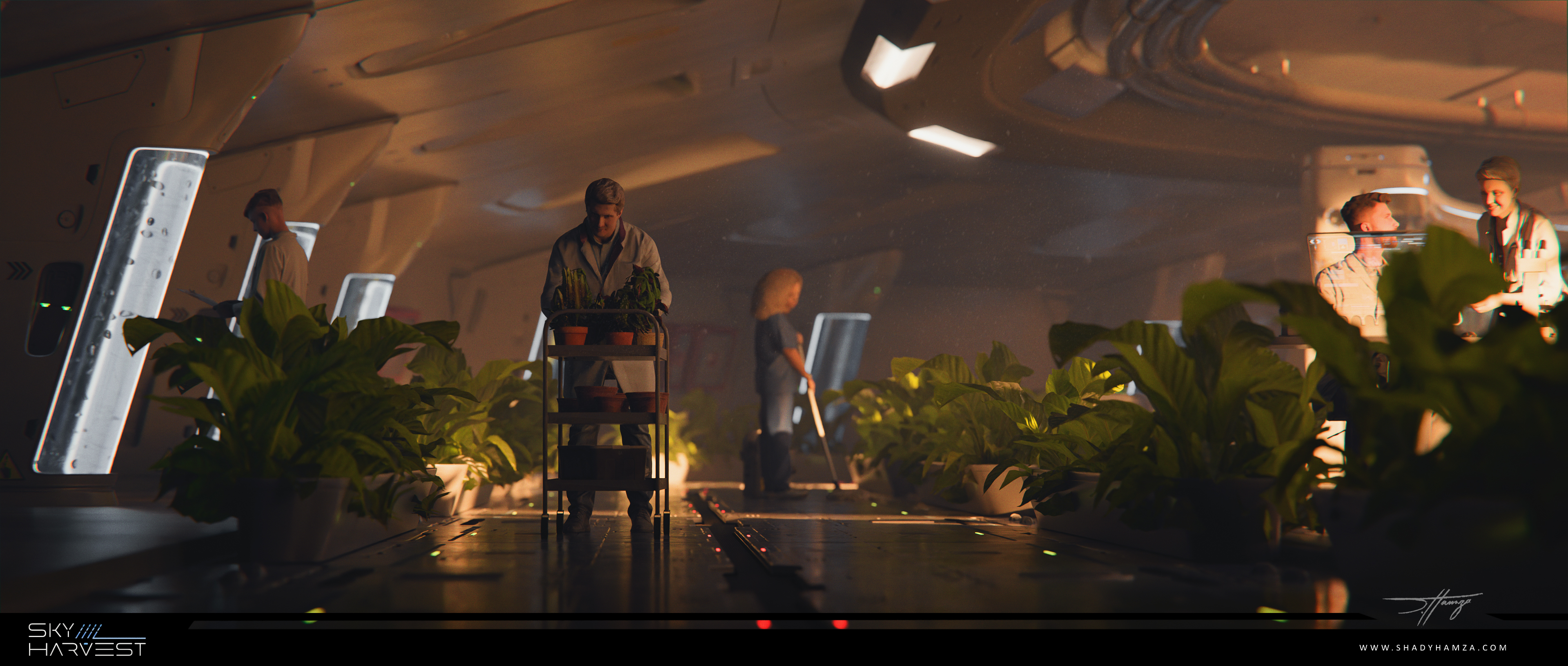
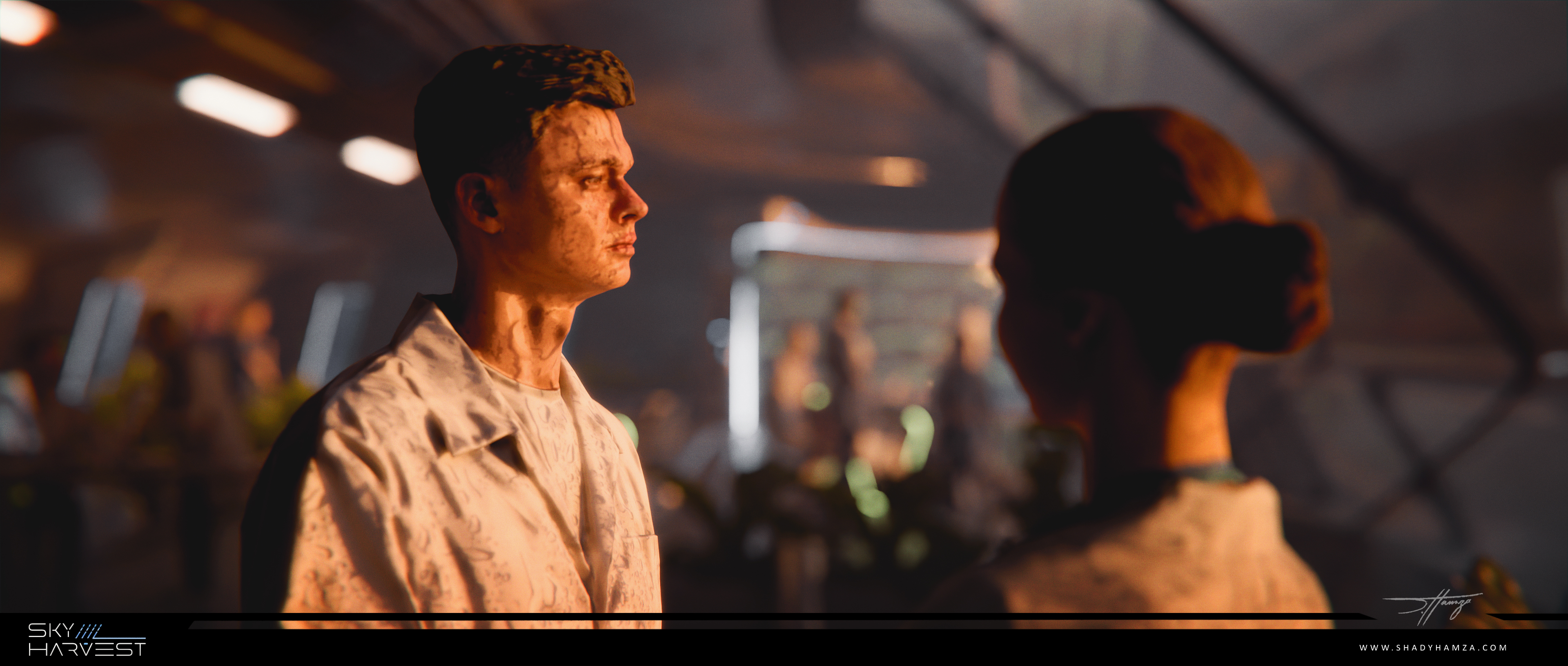
As the atmospheric system evolved from a purely environmental machine into a self-sustaining ecological infrastructure, a new requirement emerged: the platform must not only generate rainfall, but also study, guide, and accelerate ecological recovery over time.
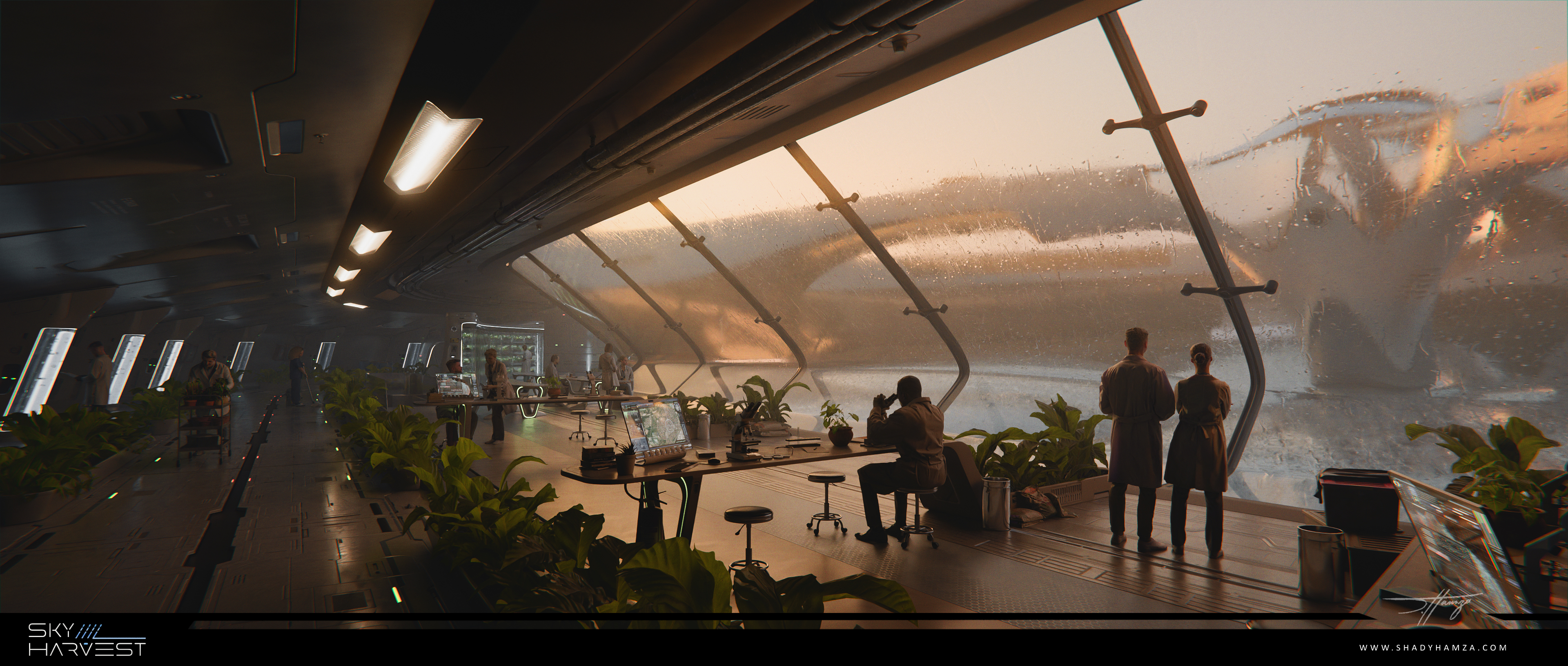
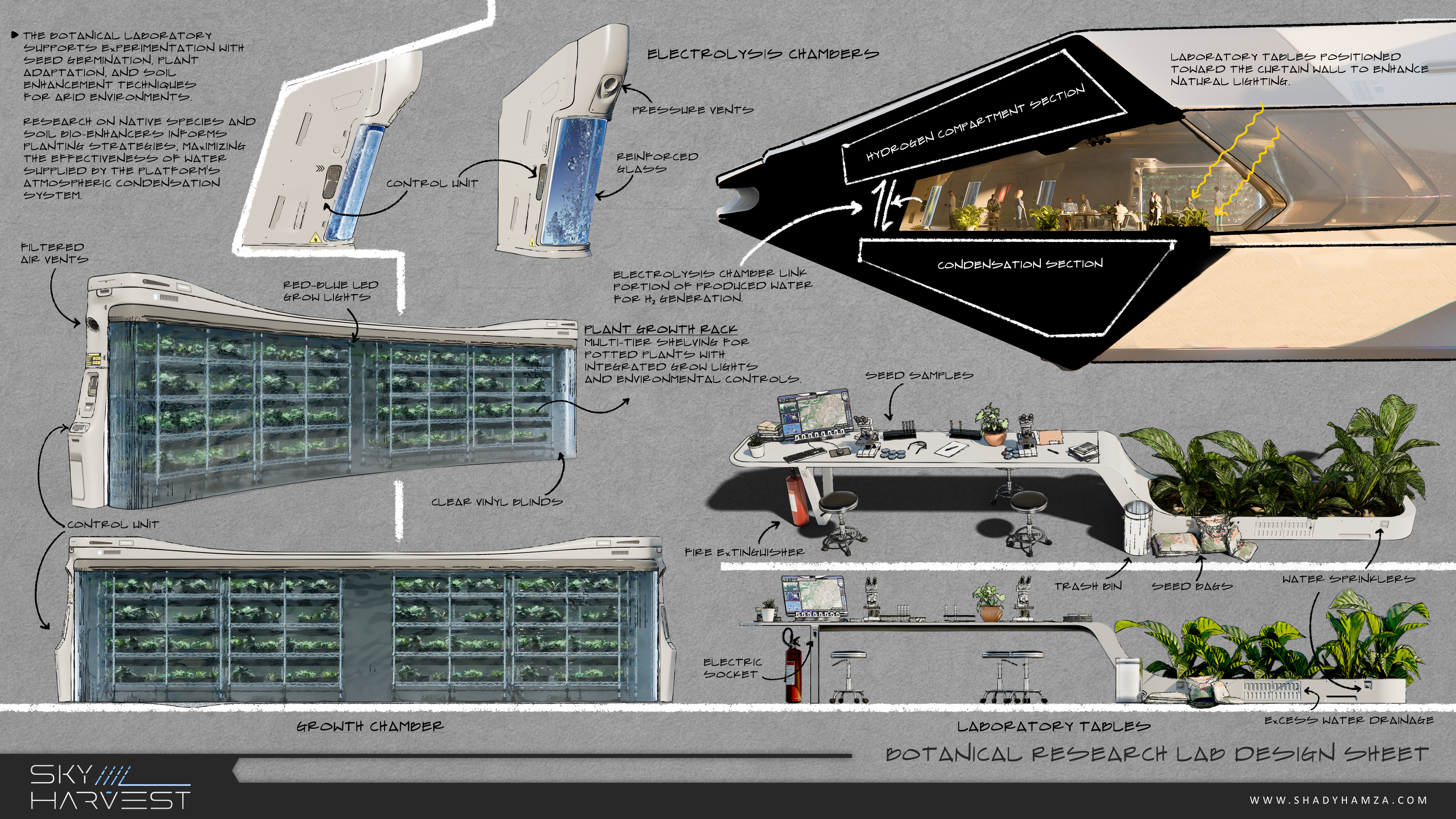
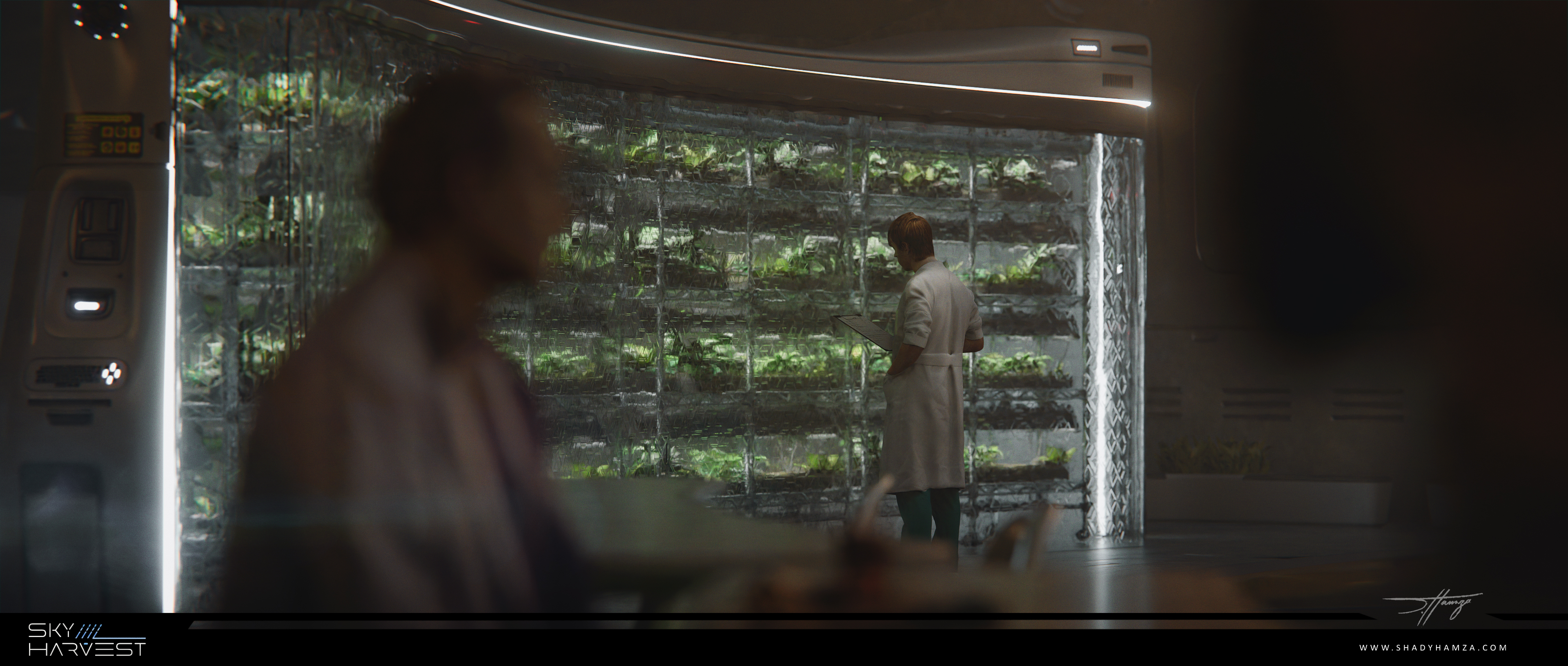
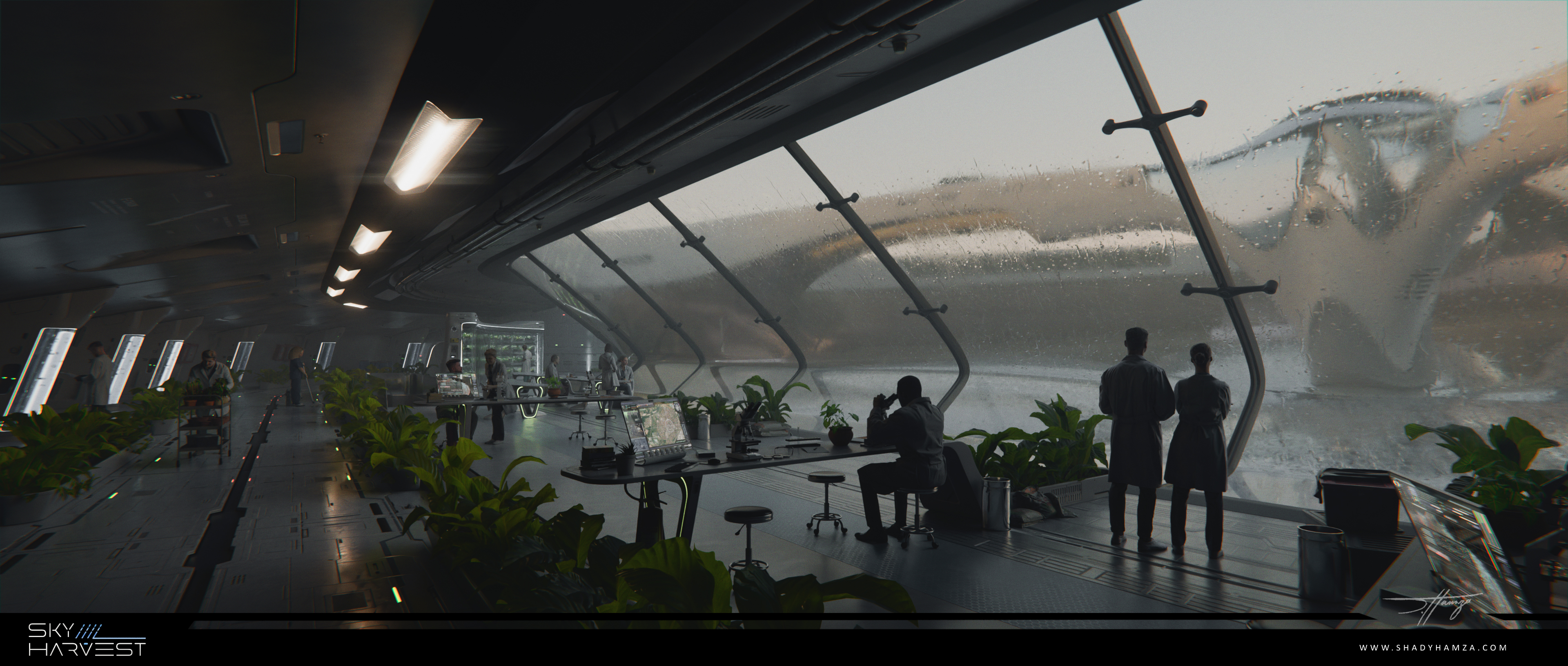
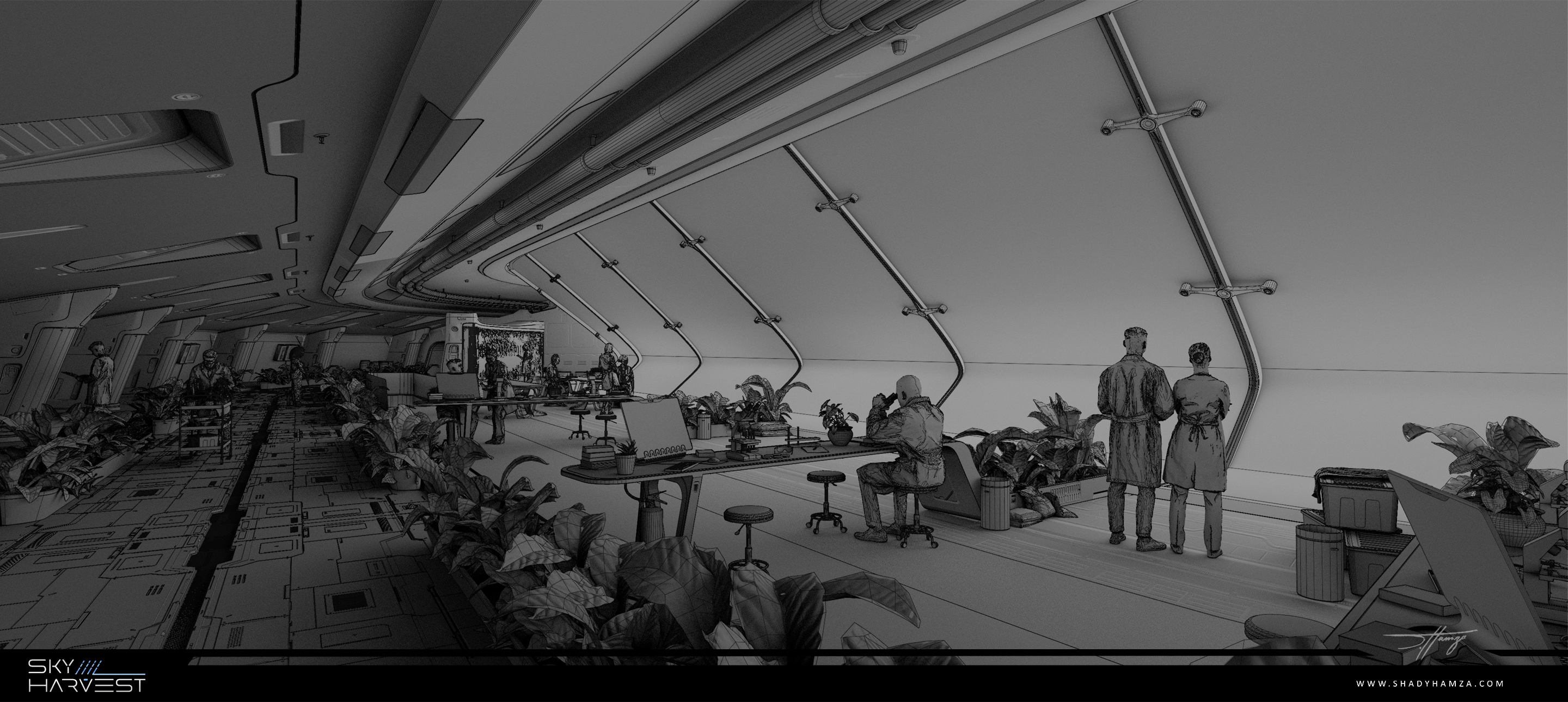
This leads to the introduction of an integrated botanical laboratory positioned within the central ring of the platform, embedded directly along the inner perimeter surrounding the condensation chamber.
Rather than functioning as an isolated research facility, the lab becomes part of the atmospheric cycle itself, allowing scientific observation, environmental monitoring, and biological experimentation to occur in direct relationship with the system’s water-generation processes.
🌿Purpose of the Botanical Core
Desert recovery is not achieved through water alone. Long-term regeneration depends on understanding:
soil adaptation and microbial recovery
plant resilience under staged moisture conditions
seed germination behavior in restored environments
ecosystem succession over time
how different species respond to artificial rainfall gradients
The laboratory transforms the platform from a passive climate device into an active ecological research system capable of refining and evolving its own restoration strategies.
🧫Perimeter Research Ring
The botanical lab is positioned as a continuous research ring wrapped around the inner edge of the torus geometry. This placement creates a direct relationship between:
- 🌧️ the central condensation chamber
- 🌱 experimental planting zones
- 🧪 atmospheric analysis spaces
- 📊 environmental monitoring systems
The laboratory effectively occupies the transition zone between atmosphere and ecology.
🔍Direct Condensation Observation Interface
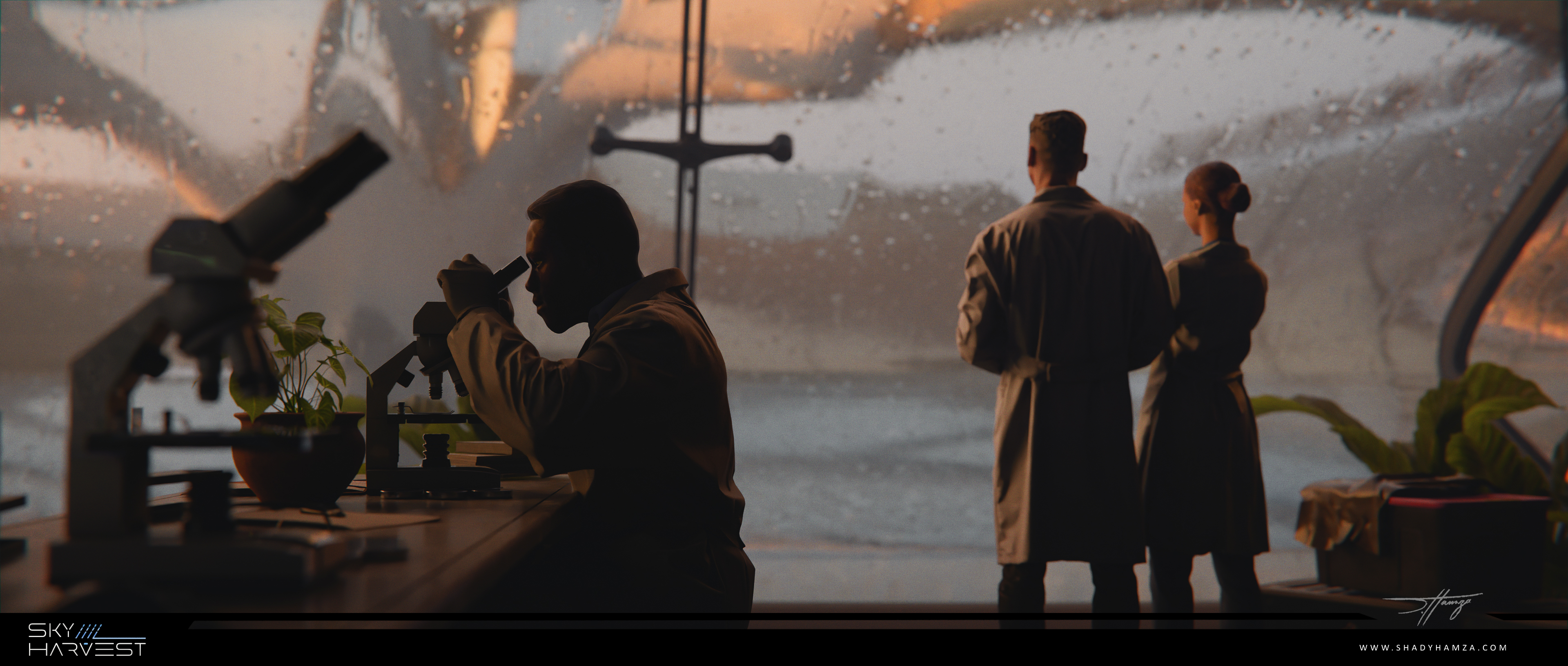
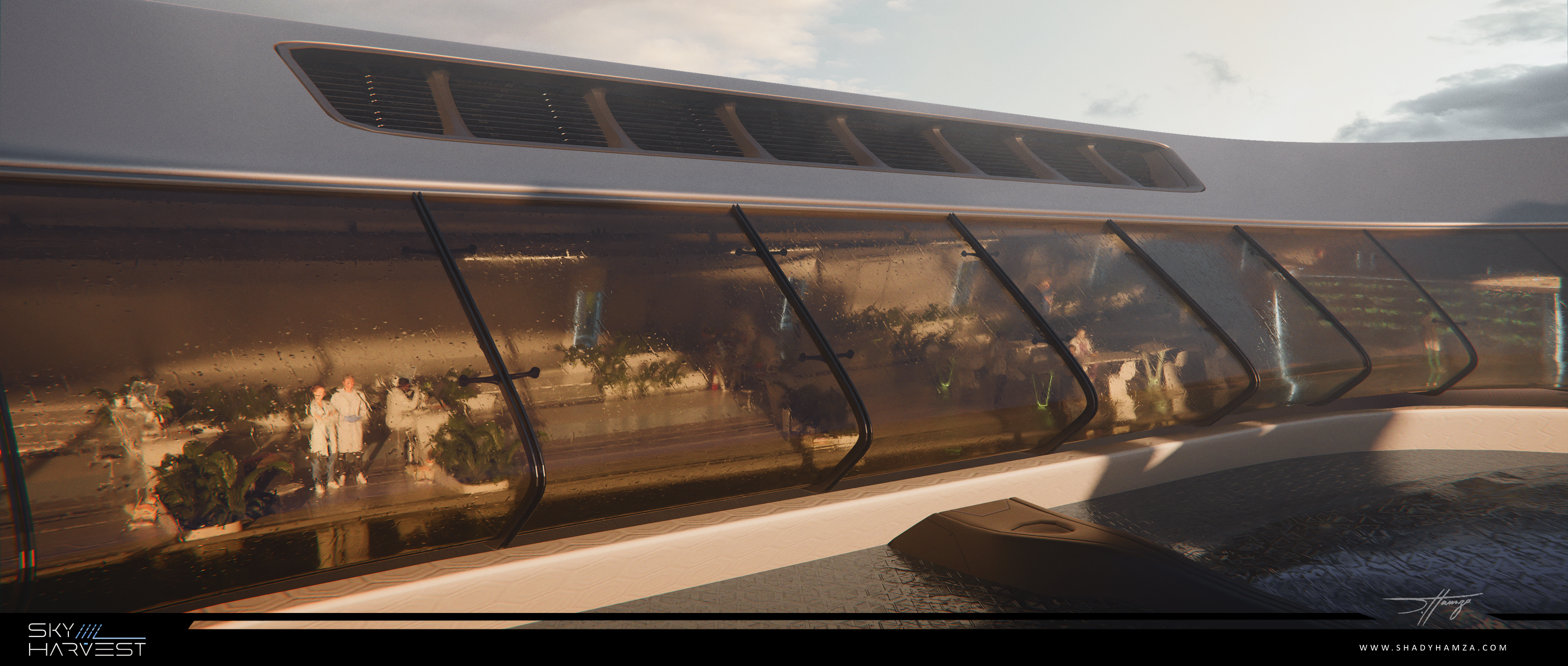
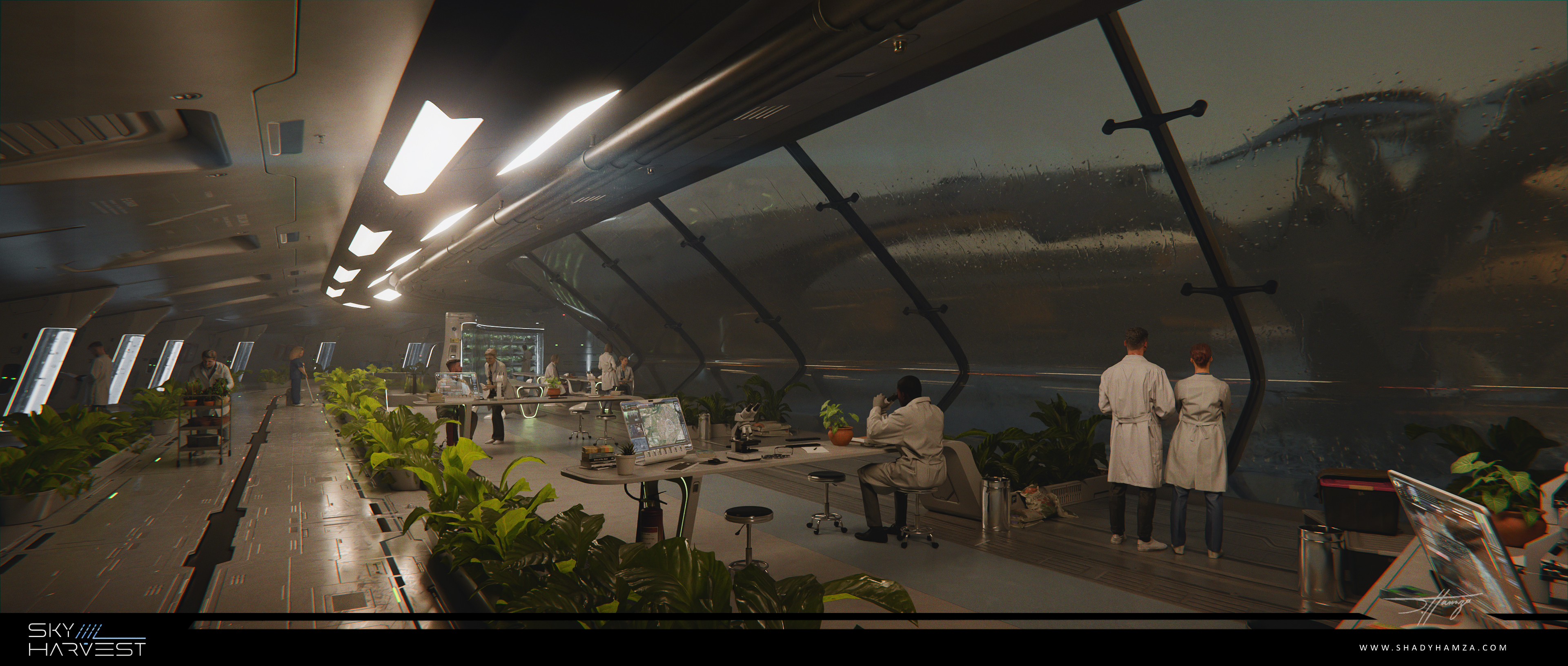
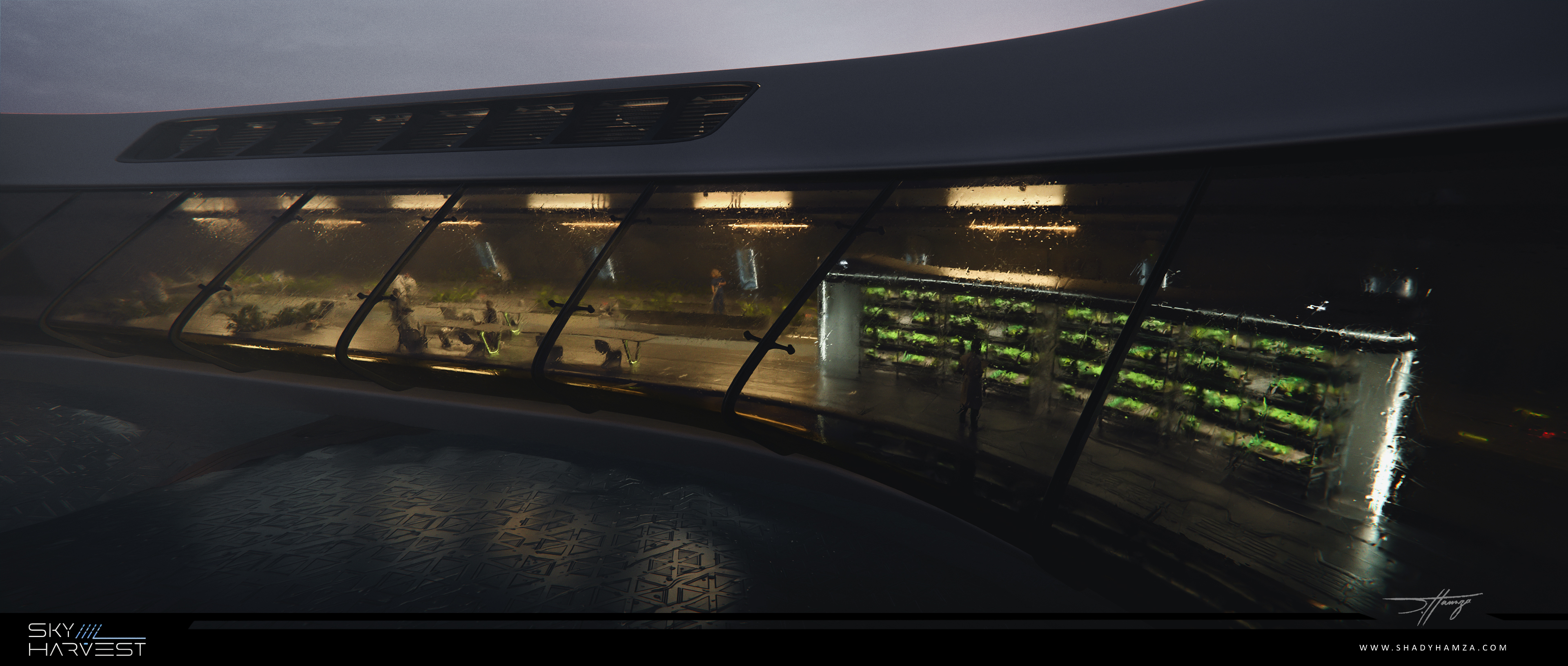
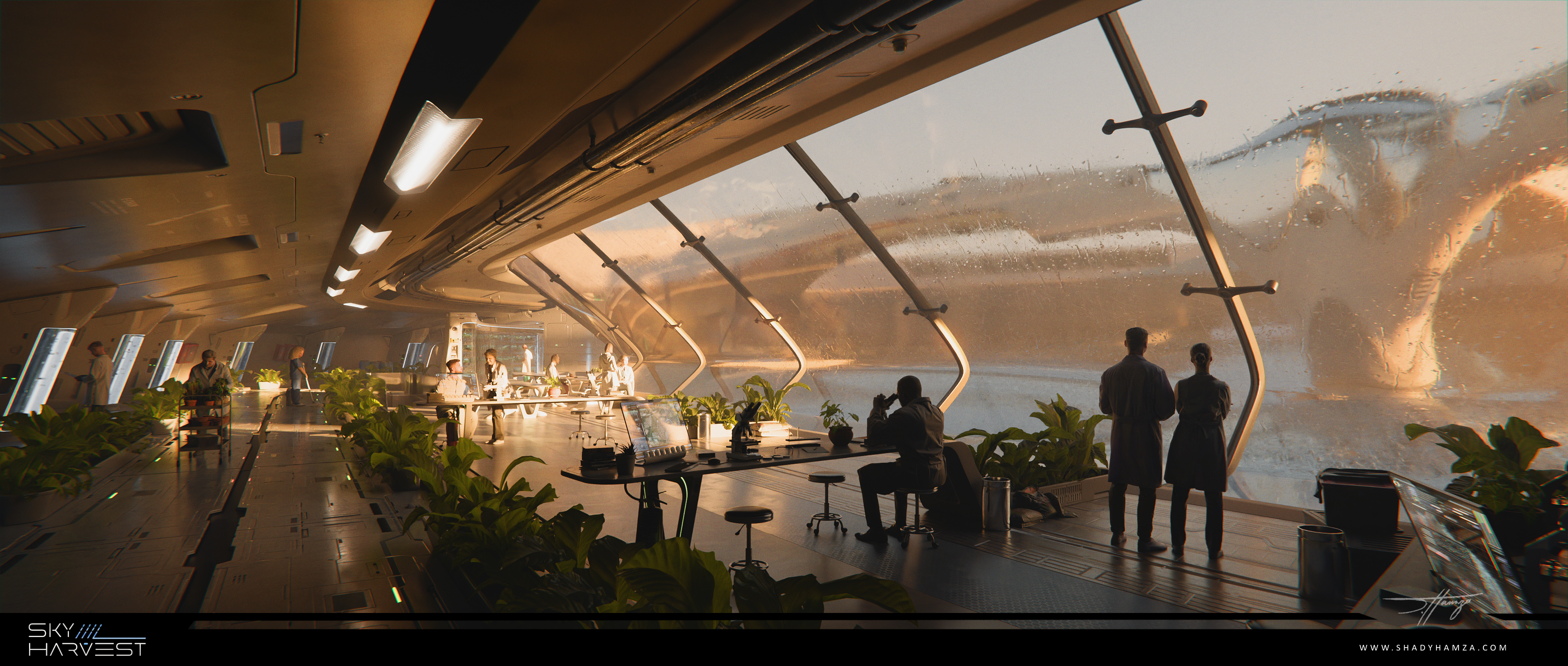
Large transparent glass surfaces face inward toward the precipitation and condensation chamber. This allows researchers and monitoring systems to directly observe:
moisture accumulation behavior
condensation density and phase transitions
airflow movement within the toroidal chamber
rainfall formation and nozzle distribution performance
atmospheric fluctuations during operation
The glass enclosure also allows continuous visual calibration between atmospheric production and biological response systems operating within the lab.
🌡️Protected Environmental Positioning
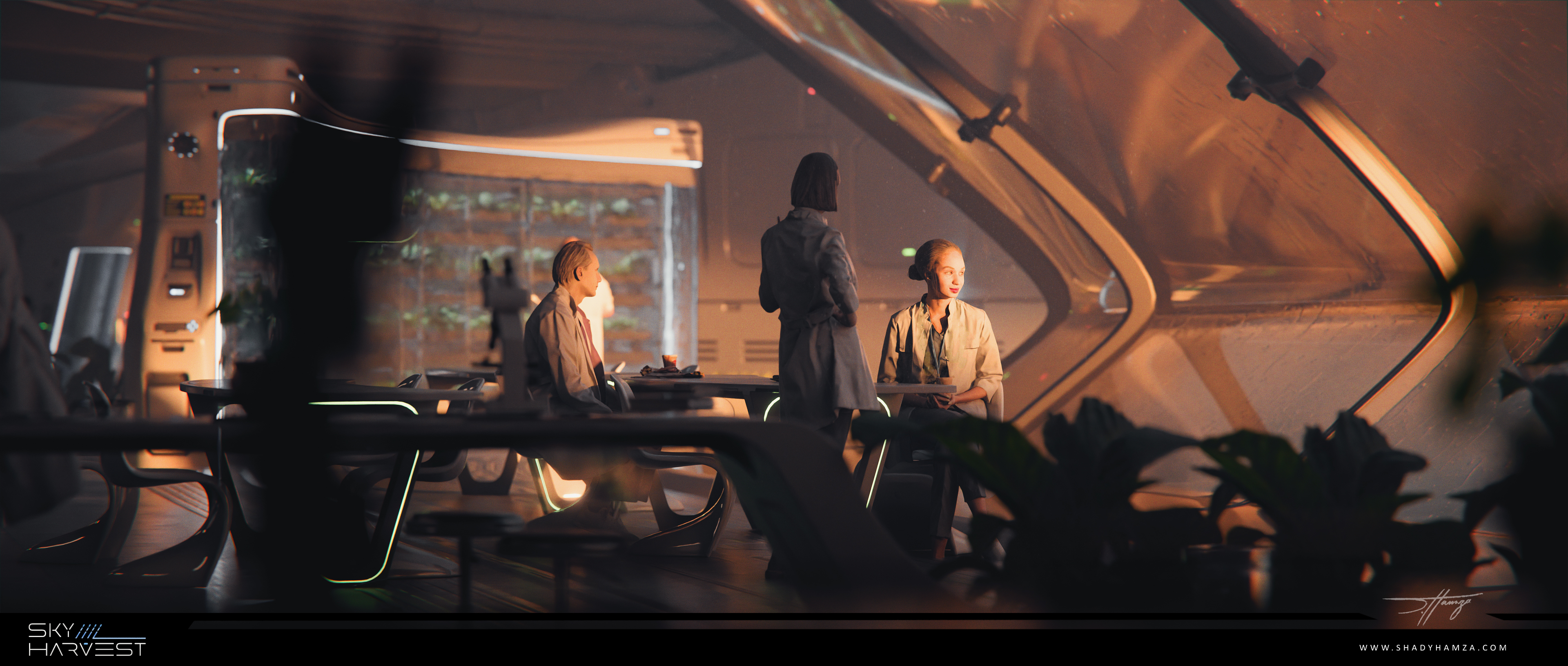
The lab is intentionally embedded beneath the upper structural shell of the platform, shielding it from direct desert sunlight and extreme thermal exposure. This creates a stabilized internal environment with:
- ❄️ reduced solar heat gain
- 🌬️ moderated airflow conditions
- 🌱 controlled humidity ranges
- 🧪 more reliable research conditions for sensitive plant studies
The shaded placement also improves thermal efficiency by using the platform itself as a protective environmental canopy. Rather than fighting desert heat directly, the architecture selectively filters exposure while maintaining environmental connectivity.
🌍Vertical Ecological Access to Ground Systems
The botanical core maintains direct visual access to the land beneath the platform through protected observation zones integrated into the lower structure. This visual connection allows researchers to continuously monitor:
- 🌱 soil recovery patterns
- 🌾 vegetation growth behavior
- 💧 rainfall absorption and surface response
- 📈 long-term ecological transformation across regenerated terrain
By maintaining uninterrupted observation between the aerial platform and the recovering ground below, the system creates a continuous relationship between atmospheric intervention and ecological response. The platform therefore operates simultaneously at two environmental scales:
- atmospheric regulation above
- ecological observation below
🔄Feedback Loop Between Atmosphere & Ecology
The addition of the botanical laboratory completes a closed regenerative feedback cycle:
- ☁️ atmospheric moisture is harvested
- 🌧️ rainfall is generated and distributed
- 🌱 soil and vegetation begin recovering
- 🧪 ecological responses are studied in real time
- 📊 findings refine future atmospheric deployment strategies
The system no longer behaves as a static machine. It becomes an evolving environmental intelligence platform capable of learning from the ecosystems it helps restore.
🌿Conceptual Outcome
With the integration of the botanical research core, the project shifts beyond infrastructure into a hybrid of:
atmospheric engineering
ecological restoration
environmental science
adaptive agriculture
living systems research
The platform becomes both a climate intervention system and a floating ecological observatory, where atmosphere, water, soil, and plant life are continuously studied as interconnected components of planetary regeneration.

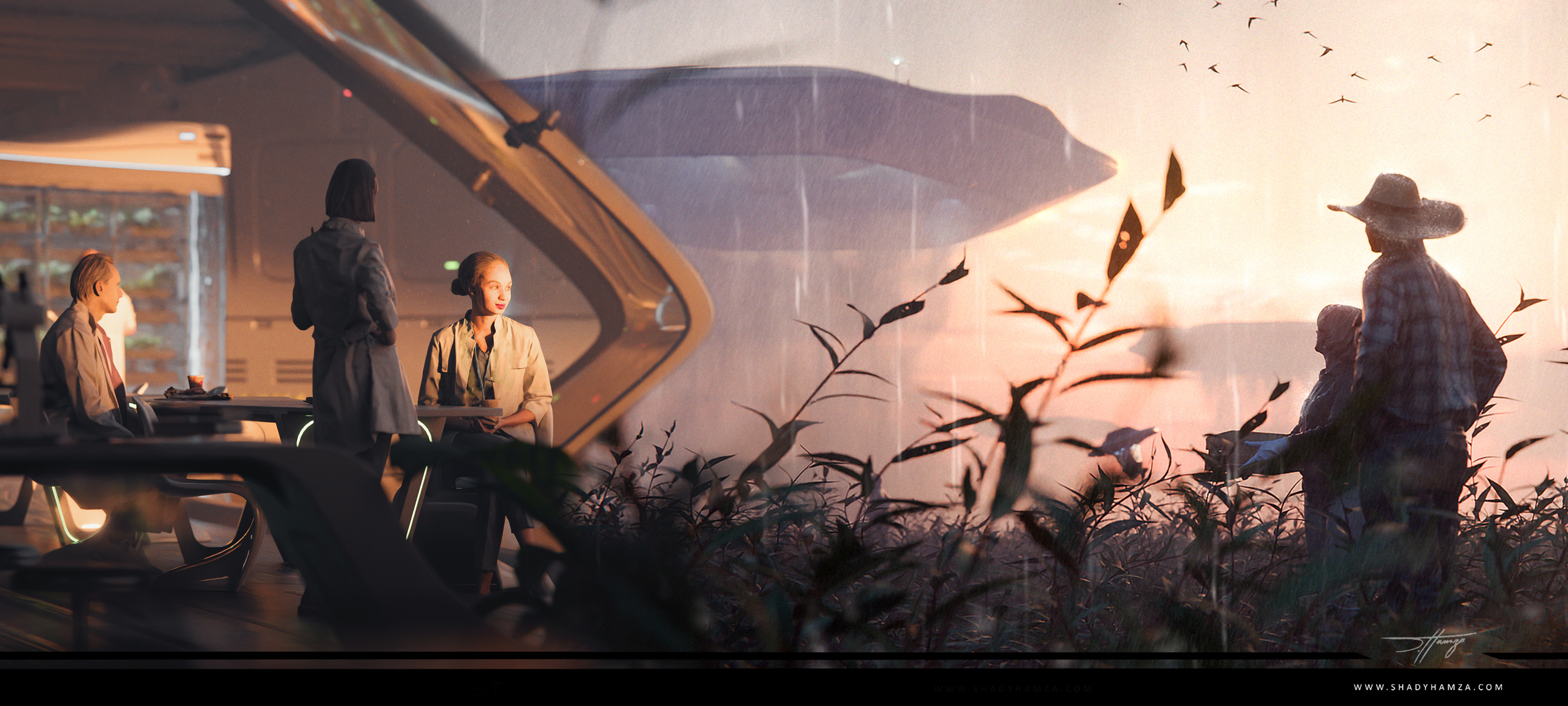
🌿A perfect future for humanity is one where we no longer see the Earth as something broken that needs to be fixed, but as something that can slowly heal when given the right conditions. In this vision, atmospheric platforms float above desertified land, gently drawing moisture from the air and turning it into rainfall that returns life to dry soil. Powered by wind, sunlight, and hydrogen-based systems, they act like quiet ecological machines that restart forgotten water cycles, soften the climate, and allow vegetation to return step by step. Beneath them, the land is not instantly transformed but patiently revived, as seeds, nutrients, and microbial life are reintroduced through carefully guided systems that learn from the environment as it responds. Over time, networks of these platforms begin to shift entire regions, not through force, but through persistence, until places once considered lifeless begin to breathe again. It becomes a future where technology doesn’t replace nature, but stays with it long enough for it to return.🌿